
There was an airport shuttle service that was very simple to book online. It was even easy to add a bike to the booking for just 5 NZD extra. I was the only one on the bus that night, arriving at Auckland International Airport at about 2 AM.
I’d booked my ticket through United Airlines (though Qantas were operating the first leg). As always when flying with a bike, I spent some time looking into the details of the booking policy. Included in the ticket price was one 23kg piece of luggage. A bike box was exempt from the normal size requirements for no extra charge – which seems strange to me; someone with a large suitcase could have to pay hundreds of dollars in oversize fees, or fly with it for free if they put it in a huge box twice the size! Not that I was complaining.
Although exempt from the size rules, bike boxes were still required to be under 23kg. If they were between 23 and 32kg there’s a 200 USD overweight fee – or a 100 USD fee to add a second 23kg piece of luggage. I decided to try packing everything into the bike box, but to put as much as possible into one dry bag. That way, if they did try to charge me the expensive overweight fee, I’d split it into two bags instead.
When I went to check in I was told to skip the queue as my bike box wouldn’t fit through the narrow queueing lane. When I checked in, they raised no objections about the bike box being overweight – as I’d hoped! Quite often the airline staff aren’t totally sure about the bicycle policies and sometimes that can be an advantage.
The first leg of the journey was to Melbourne, a 4 hour flight in the wrong direction. While I was waiting around for my visa appointment, I’d considered going to NZ first, returning to Australia for the visa interview, and then going to the US from there. Absurdly, it was hugely more expensive to fly from Melbourne to the US than it was to fly from Auckland to Melbourne to the US. It makes no sense to me that adding an extra flight to a ticket should drop the price by hundreds of dollars but there we are.
During boarding I was asked if I’d be willing to move seats to be responsible for the emergency exit. That meant extra legroom for me so I did so. We experienced quite a bit of turbulence during the flight and it was quite something to watch the wing wobbling and flexing as we bounced.
The transfer in Melbourne went smoothly and after a couple hours I was in the air again, headed to San Francisco. This was a 14 hour flight, the longest I’ve ever taken! On landing in SFO the queue for customs took just over an hour. And after that I was told I’d need to go for further interviewing by border control agents.
It was another hour and a half before they called my name. Of the 50 or so people having further interviewing, there was only one other white person – an underage girl who was there because she was travelling unchaperoned and seemed generally confused about her itinerary. Many people missed their flights and I was quite glad this was a ten hour layover!
Eventually I was called up to the desk and it became clear that the issue was related to my previous visit to the US, in 2017. Because I’d exited overland they had no record of it. They asked me some questions about my travels/life. They asked to see a bank account balance and then were satisfied. It seemed they amended their records and handed my passport back; I was free to go.
When chatting to some other passengers on the plane, I found out that when entering the US and transferring to a domestic flight, it’s necessary to collect and recheck any checked baggage. I’d not been told anything about this when checking in at Auckland but I confirmed this online and with several airline staff at the airport. However, my bike box was nowhere to be seen.
The bag tracking system was pretty useless – it just confirmed the box had been checked in in Auckland. The airline staff I spoke to said there was nothing they could do as, until I arrive at my destination, my bike isn’t technically delayed as it could have been sent on a different plane. I had no choice then but to simply continue on without the bike and hope it would meet me in Alaska.
After the rest of my long layover I boarded the plane. Before takeoff I checked the tracker again which now confirmed that my bag was being rerouted, and had arrived in Melbourne.
This final leg of the flight brought me to Anchorage. I went to the baggage claim place and after quite a bit of waiting around, they booked a hotel for me. I expected them to try and pay the minimum possible for a cheap motel (which I’d have been fine with!) but they ended up paying $360 for a room. I took a shuttle bus there with three other guys who’d also had their rooms paid for by the airline.
In the morning the tracker said the box had arrived in San Francisco and was due to arrive in Anchorage that night. I checked out of the hotel and headed back to the airport.
The baggage claim area was closed when I got there and I waited around for a couple hours. The same woman was working there as had been the night before. She gave me another hotel voucher and more meal vouchers. I returned to the hotel.
That evening I took the shuttle to the airport, again. I used up the last of my meal vouchers while waiting for the bike box. I was very pleased to collect it and return to the hotel. I set it up, had a night’s sleep, and set off the next day.
It was strange to be riding on the right hand side of the road again! I made my way through Anchorage. It’s a big city, especially in terms of area – the first 100km of my ride was officially through the larger metropolitan area. Roughly half of Alaska’s population lives here. It’s very spread out, though, and as I rode on a highway with trees either side and snow-capped mountains in the distance, it didn’t feel like riding in a city.
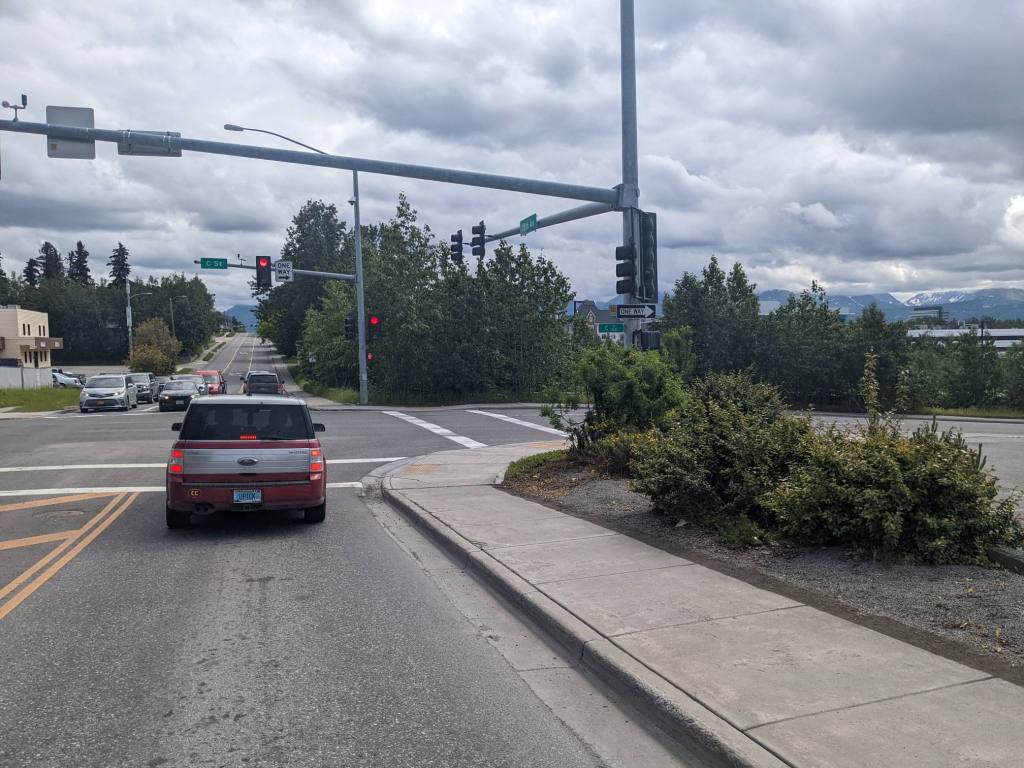
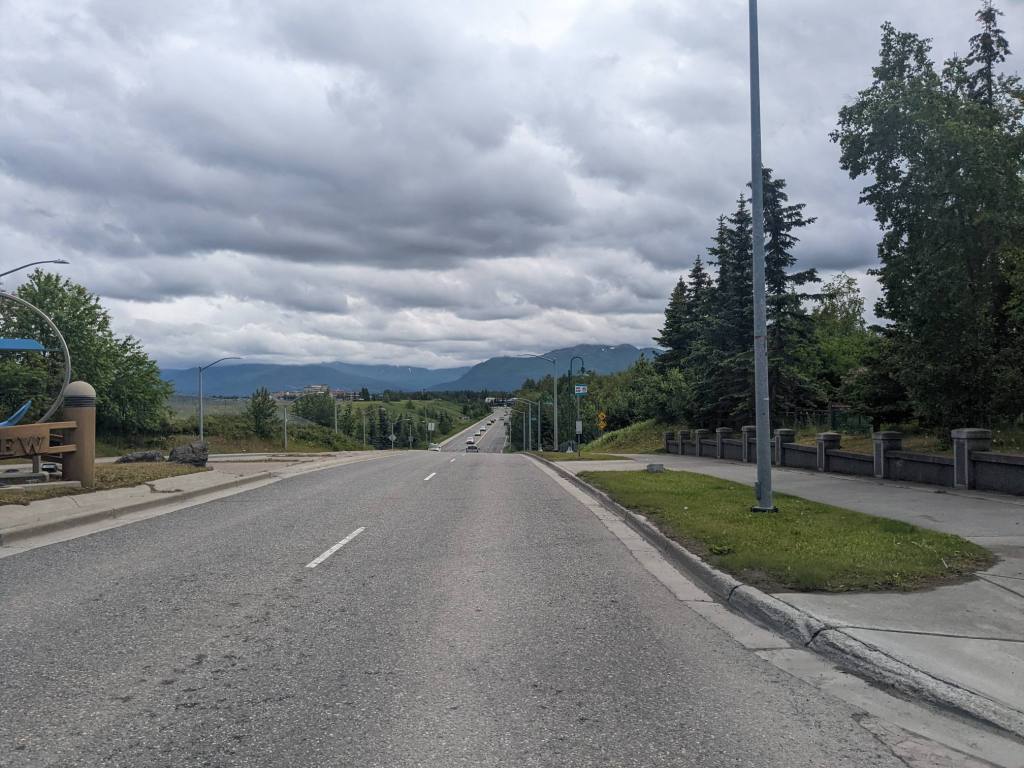
I stopped at Walmart to buy food for the next 600km or so to Fairbanks. I’d heard that prices in Alaska were very expensive, but I couldn’t tell if that was true – I had to Google how much an ounce weighs first. I worked out a conversion rate that the price in GBP/100g is roughly triple the price in USD/oz. Prices were not as expensive as I’d thought they might be.
For the first few hours of the day I passed through towns that, while technically part of Anchorage, seemed distinct with big gaps in between. Mountains and lakes abounded.


An unfortunate consequence of all these lakes was the mosquitos. When I stopped for a break the air soon swarmed with them. I quickly packed up and decided I’d eat while riding.
I was surprised and impressed by how often there was a bike path running parallel to the highway. It lasted for most of the first 120 kilometres, after which there was still a wide shoulder. Traffic lessened as I left urban areas behind, riding through forests instead.

Pretty much all of the time I’ve spent touring, my daily life has been governed by the sun. I typically stop around sunset and depart after sunrise. I try to be aware of how long until it gets dark, and try to have an idea of where I’ll be when it does, so I can figure out somewhere to camp. In New Zealand I only had about 8 hours of daylight to work with. It was strange, then, to be so far north that it didn’t really get dark at all.
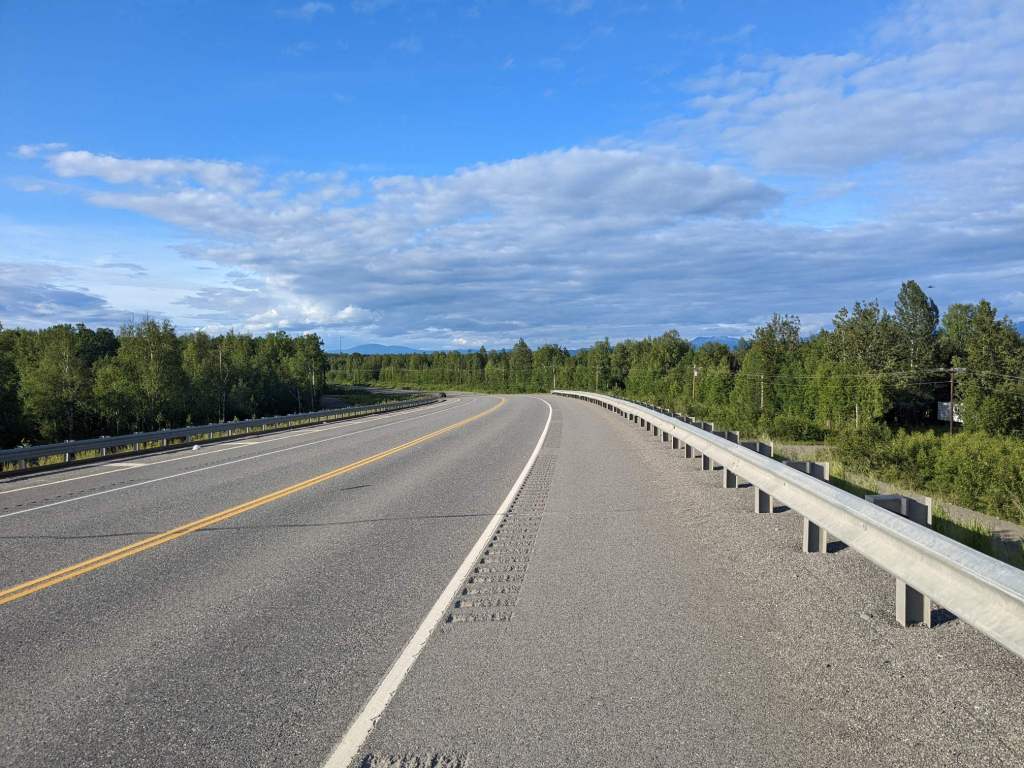

I rode into the evening and beyond, with the sun in the sky. At 11.30, about half an hour before sunset, I made my way over to a gravel area to set up camp. The air quickly became almost solid with mosquitoes, and I changed my mind. I rode on a bit further to a rest area marked on iOverlander. Signs on the picnic benches instructed campers to place any food items in the bear-proof containers provided. There were no such containers!
The sun set at midnight and rose at around 4, though it stayed light between those times. I woke up at about 7 when the sun made it too warm for me to stay in my sleeping bag. I hadn’t really had enough sleep and was quite tired for the rest of the day.
The rest area I’d camped in had a viewpoint out over Denali, the highest mountain in North America.
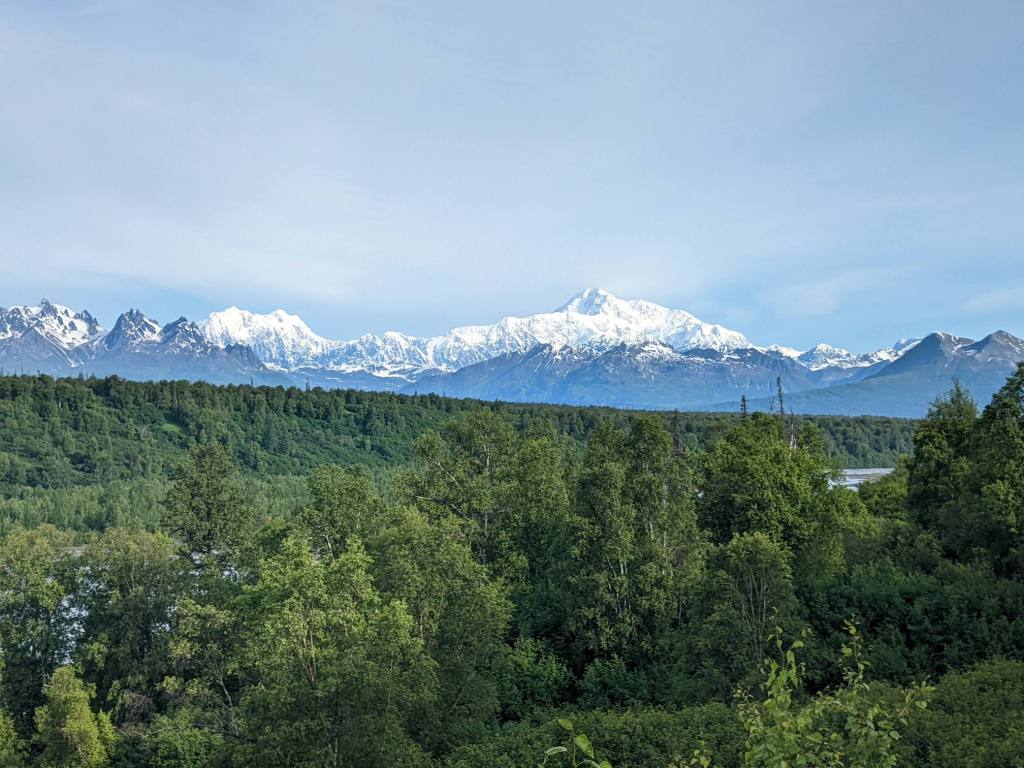
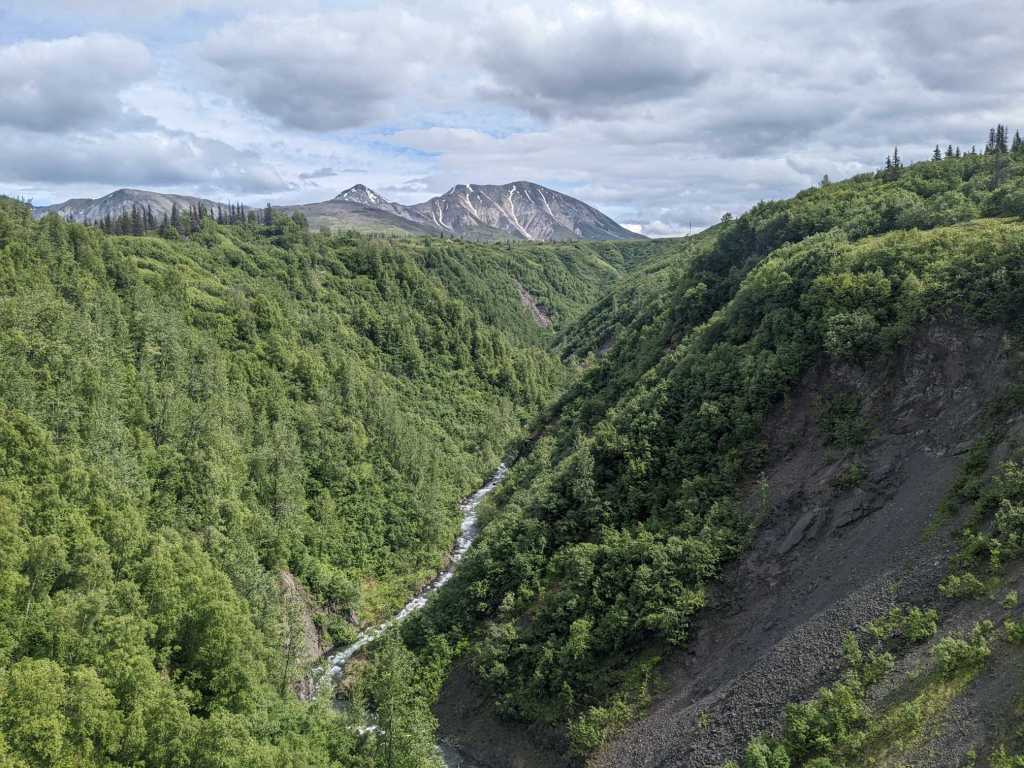
The road went generally uphill for most of the day. The scenery was generally amazing. It was almost completely unpopulated, and every turn seemed to provide a different view of mountains.


The road topped out at a plateau around 750m up. The wind was stronger there and I was able to stop for a break without being bothered by mosquitoes. Some dark clouds rolled in and it began to drizzle.

Around 9 PM I wandered into the woods and set up camp in an area cleared for an electrical line. I scraped my leg on a stump on the way in but did not properly check the cut as I raced to put on extra layers to defend against mosquitoes. The next day I had to spend some time digging out splinters with a needle.

There was a bit of wind in the morning and I removed the rain fly from the tent before getting out, in the hope the swarms of mosquitoes between the inner and outer tents would be dispersed. It helped, a bit.
After an initially scenic ride past mountains and through a canyon, I settled into a long gradual descent through the forest.
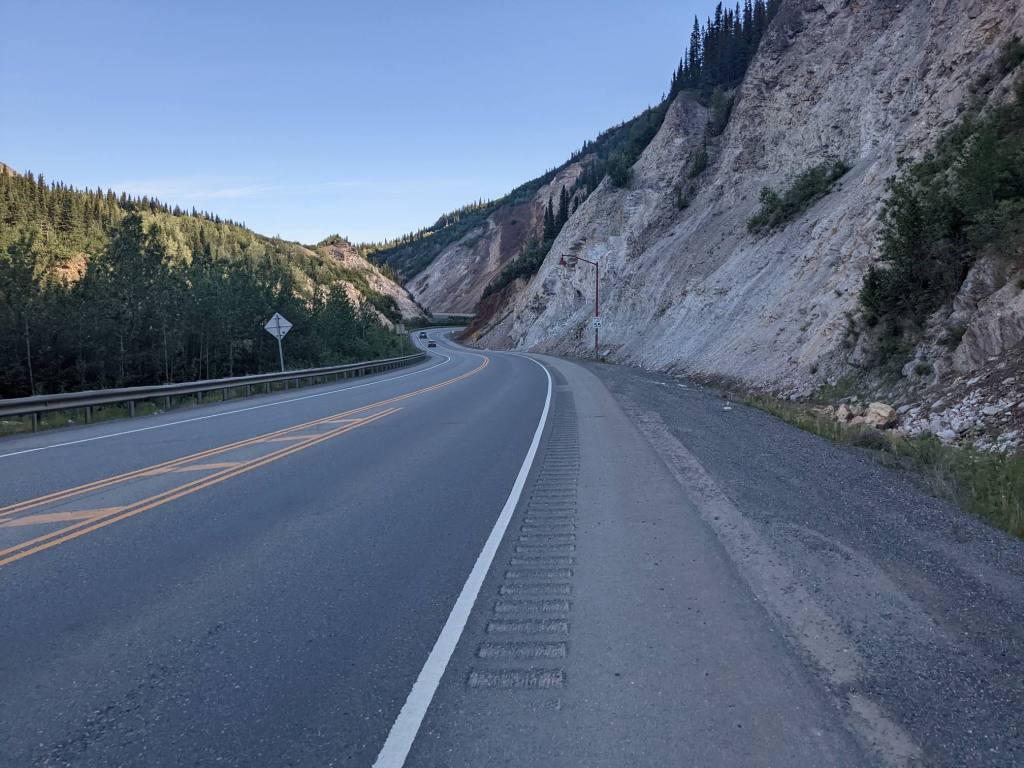
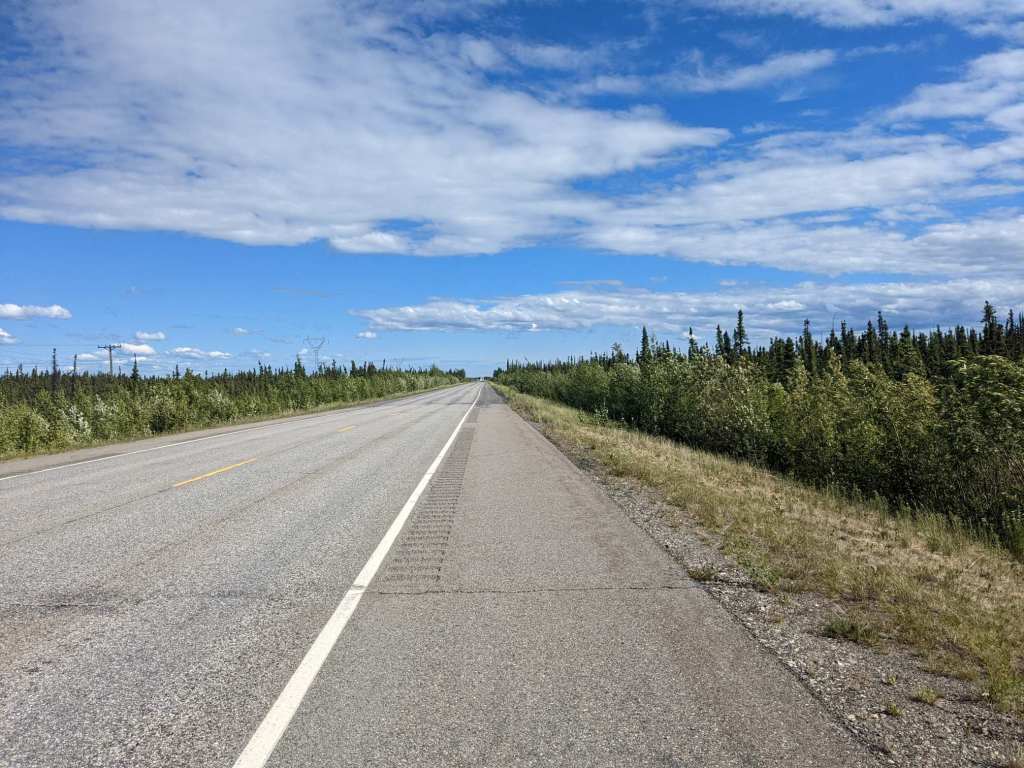
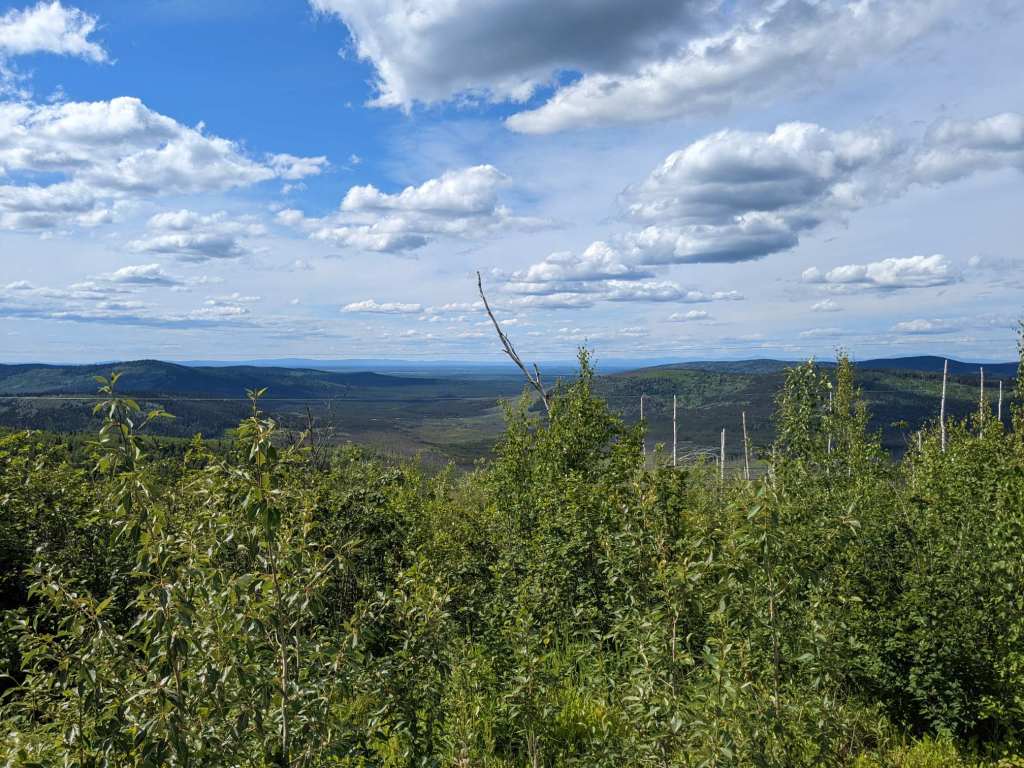
A tailwind combined with the downhill meant I was flying along for the first few hours of the day, until I turned east and entered some hills. The wind had mostly died down by then which was a relief as it would have been against me. I cycled along a ridgeline with views out over huge expanses of forest on both sides.

I was approaching Fairbanks, the last town before a long empty stretch. I wanted to pick up some things there but it was Sunday evening. I stopped early, before reaching the town, and set up camp in a forest. As was becoming my custom, as soon as I stopped I put on my trousers, coat and a head net, to ward off the omnipresent mosquitoes.
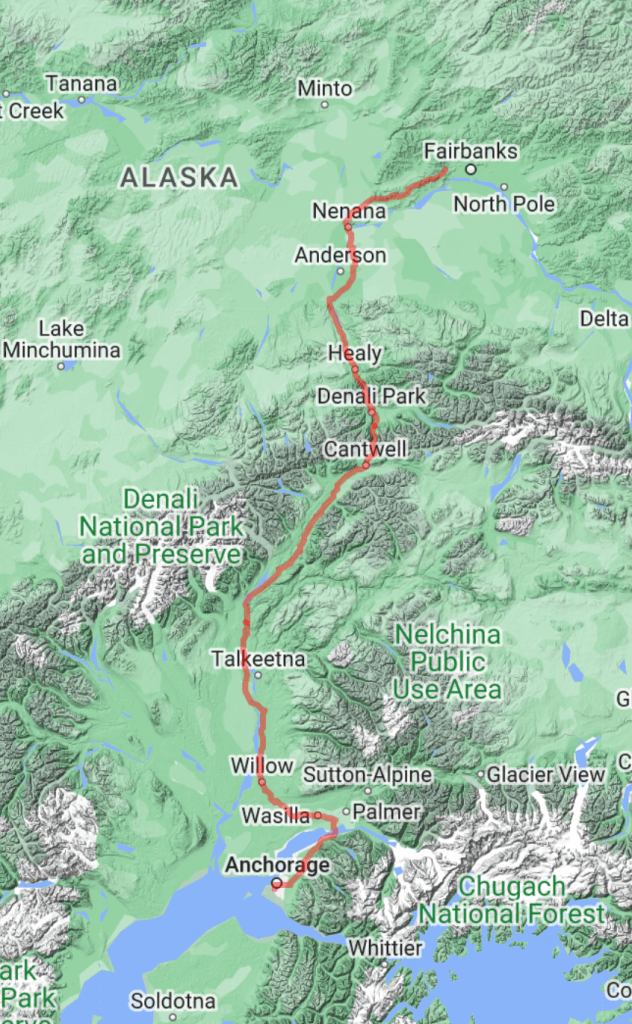
June 30: 222 km
July 1: 145 km
July 2: 198 km
 Cycle Touring Sam
Hi Sam
An amazing leg of your trip. A few challenges and I got quite worried about the absence of your bike !!
You survived the onslaught of mosquitoes and saw the amazing scenery. Amazing pictures. Loved them. My last house was called Fairbanks. A bit of history there. Look forward to the next leg. Lynda
LikeLike
More fantastic adventures Sam. Great photos too. Glas your bike wasn’t too delayed.
LikeLike
Great Scenery- very inspiring legs in Alaska. Just wondering how you manage 200+ km in a day. Obviously you have very short nights!
LikeLiked by 1 person
Thanks Simon. I typically average about 20 kph while I’m riding. I have 8 hours of sleep, and typically take an hour or so for each of making camp and breaking camp. That leaves 14 hours of travel time, including a few hours of breaks.
LikeLiked by 1 person