
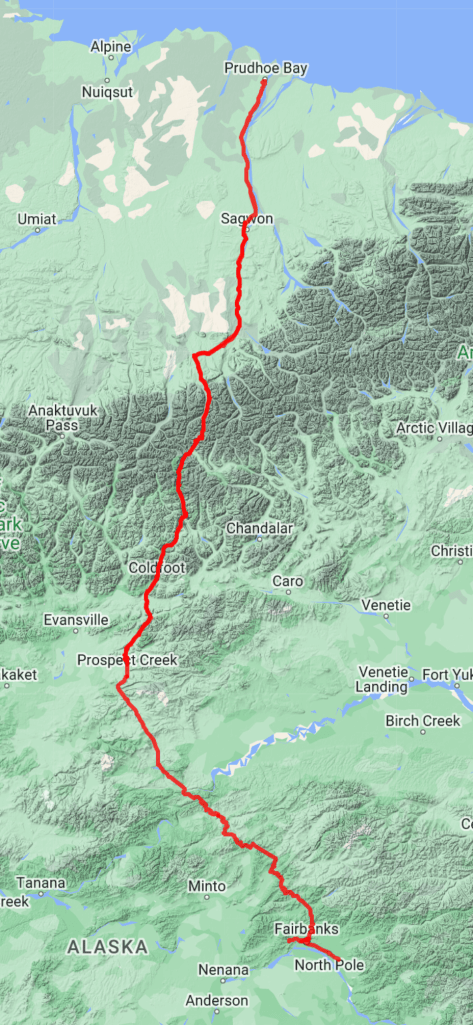
I packed up and rode into Fairbanks, then headed to Walmart. I needed a shopping trolley to carry all my stuff as I loaded up my bike with more food than I ever had before, in preparation for the Dalton Highway. This road goes to the Arctic Ocean (and back) and is 1600km long, mostly unpaved.
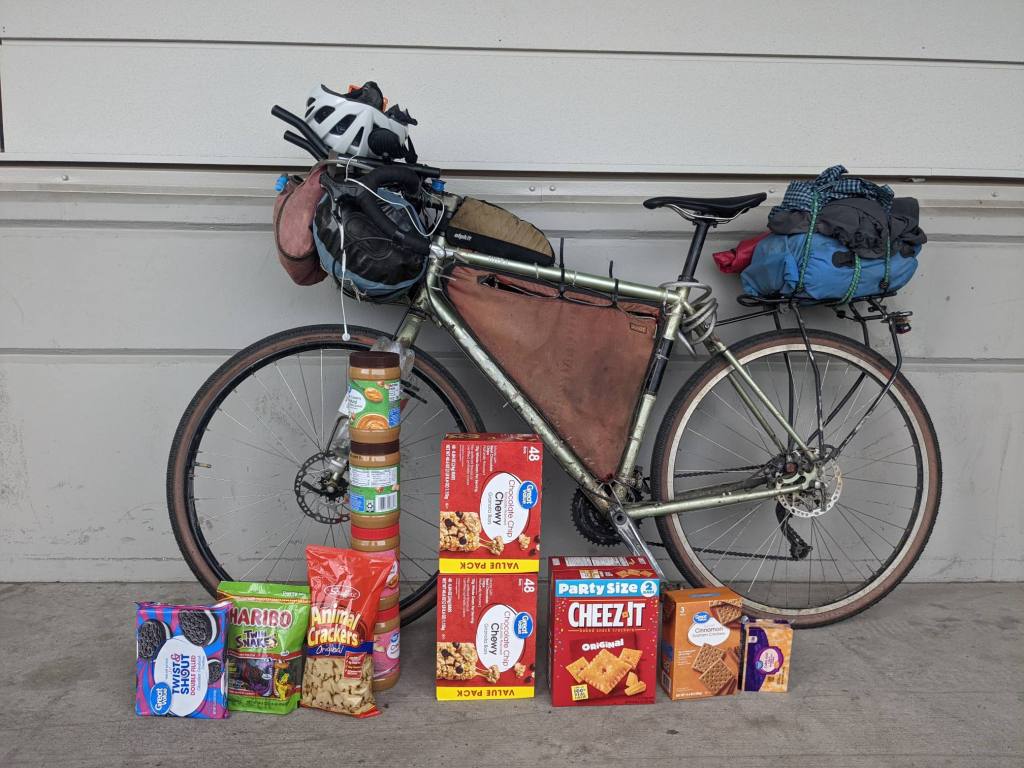
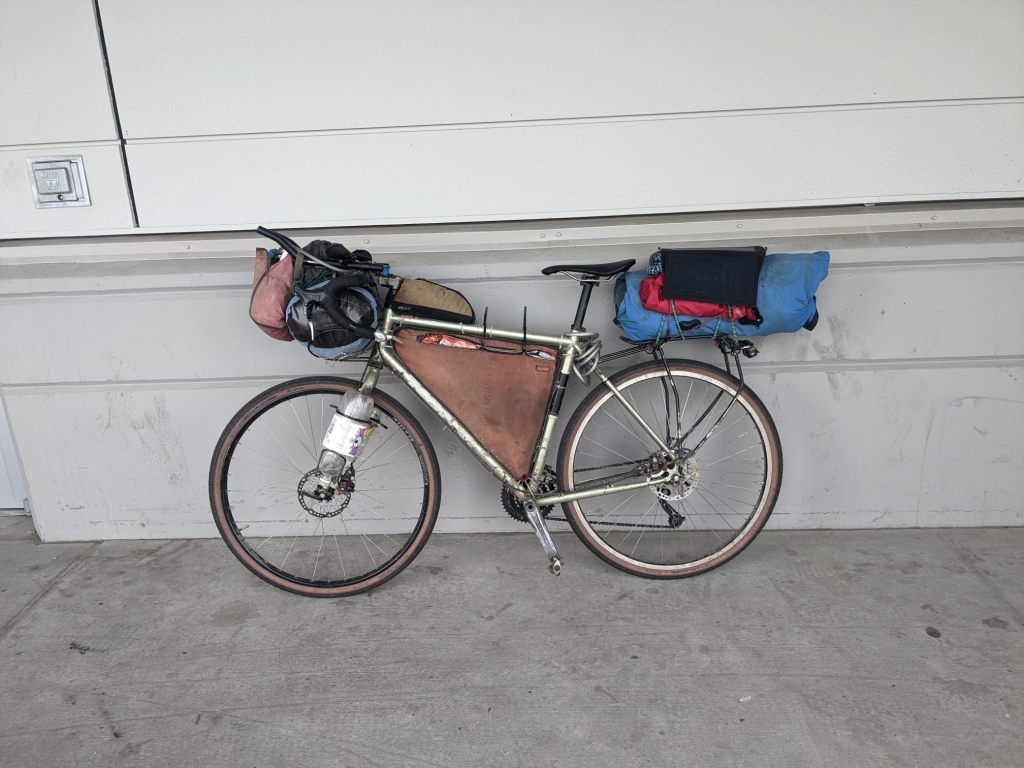
I bought 48,000 calories worth of food for about $50. This was in addition to the roughly 4000 calories I already had on the bike. Packing it all in was something of a challenge but I managed to do so. It would have been a lot more difficult when I still used a saddle bag – the bag atop my rear rack held most of the volume.
I then went over to REI, a sporting goods store. I bought some protection from Alaska’s two main wildlife dangers – bear spray and mosquito spray. When I left I saw two touring bikes parked outside, though I didn’t talk to their owners. Instead I went and caught up to the two touring cyclists I saw riding nearby.
They were Anna and Hope, riding from here to Idaho. We talked a little; like most people they commented on how lightly loaded my bike was considering how long I’ve been travelling. It didn’t feel lightly loaded with all that food! They were looking for REI and I told them they’d just gone past it.
A couple hundred metres later was another pair of touring cyclists! These two were from New Zealand and had just ridden from Deadhorse. We spoke briefly then I continued on and stopped for a break to make a start on all the food I was carrying. While there yet another cyclist came past, Lukas, who has also ridden from Deadhorse and was headed from Argentina.
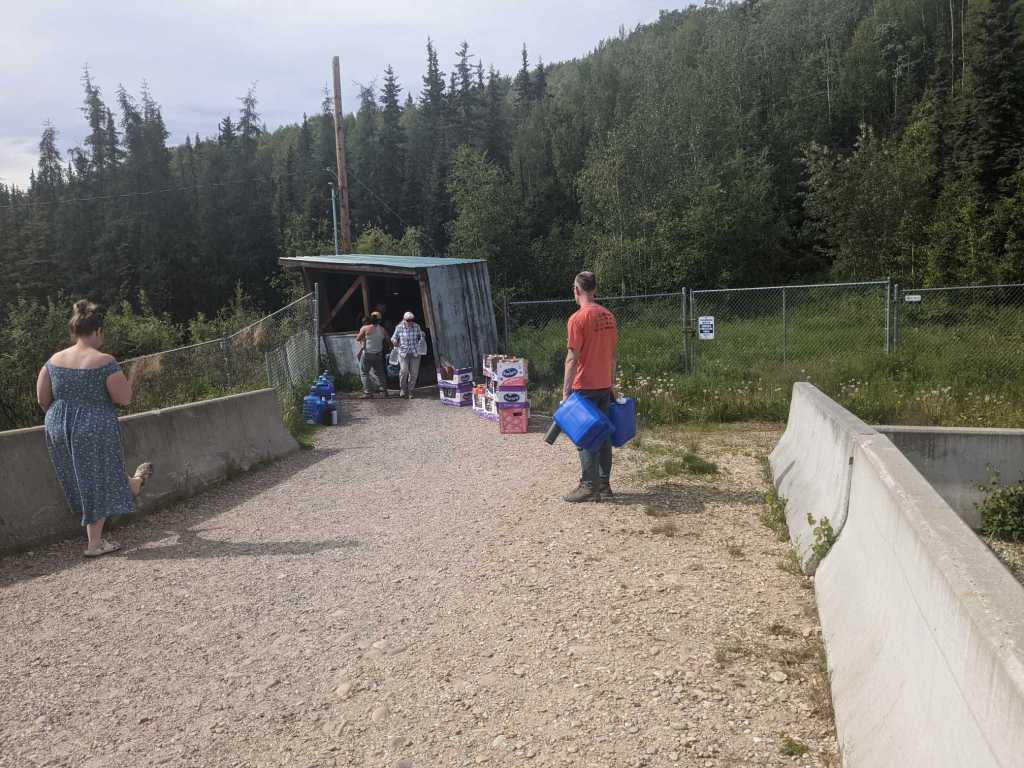
At the edge of town was a spring, where I stopped for water. Evidently locals got their water there too – people were filling up with hundreds of liters.
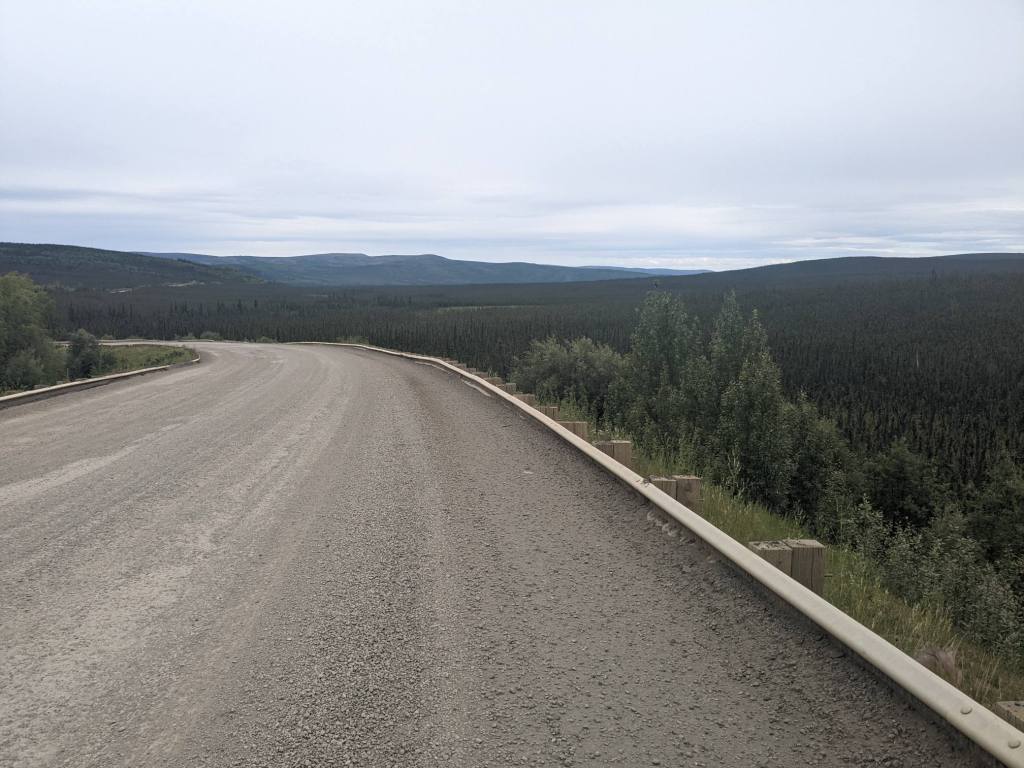
From Fairbanks the road undulated constantly. Initially my bike felt very heavy with the 11kg of food I was carrying, but after a while I got used to it. After all it was even so probably lighter than most people’s touring bikes would be without food.
This was the first road I’d cycled in the US that didn’t have a wide shoulder. I was amazed at how courteous the drivers were. I’d grown accustomed to lots of close passes in Australia and New Zealand but here drivers pretty much all crossed over to the other side to pass.
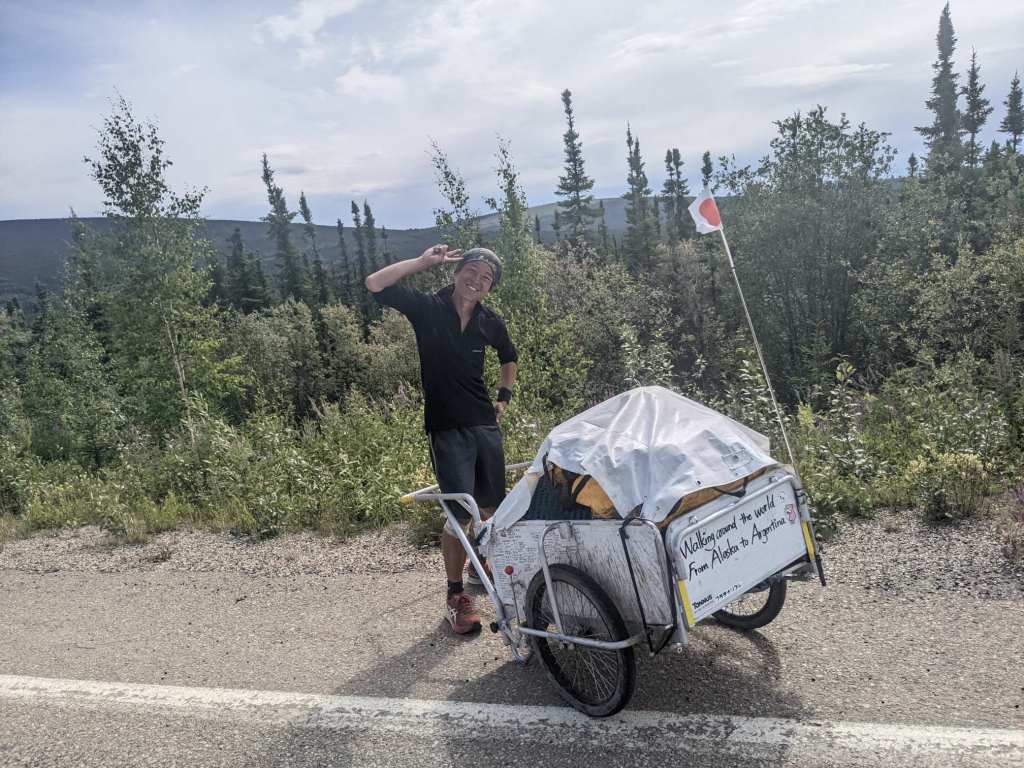
I saw another pair of touring cyclists riding the other way, and then met a hiker. Suchi had dragged his cart from Deadhorse, which had taken about three weeks. He was planning on walking all the way to Argentina.
The road continued its constant up and downs. I stopped to collect water from a river at one point and the water was clear enough that I didn’t bother treating it. Getting down to the river involved being followed by a swarm of mosquitos which wasn’t much fun!
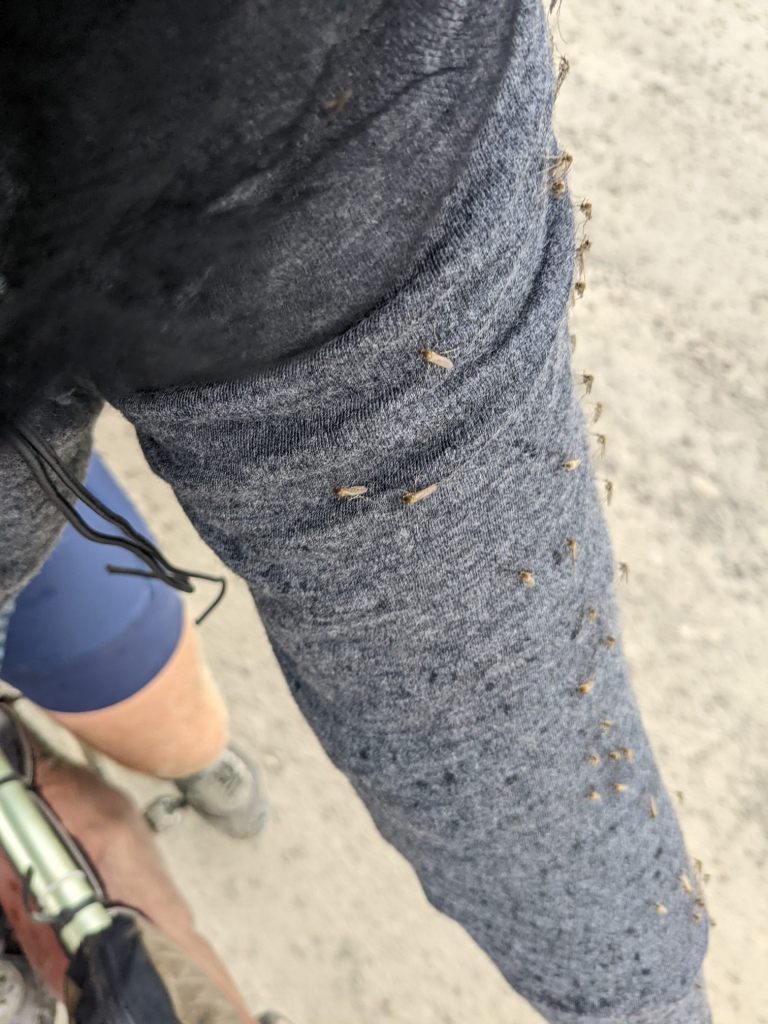
About 120km from Fairbanks, the tarmac ended and the Dalton Highway officially began. The dirt road was in very good condition but the main difference was that the hills were now noticeably steeper. The mosquitoes were able to keep up with me. I sprayed insect repellent on my skin but that only did so much. I ended up riding with my shirt and head net on; it was uncomfortably sweaty but that was nicer than mosquitoes.
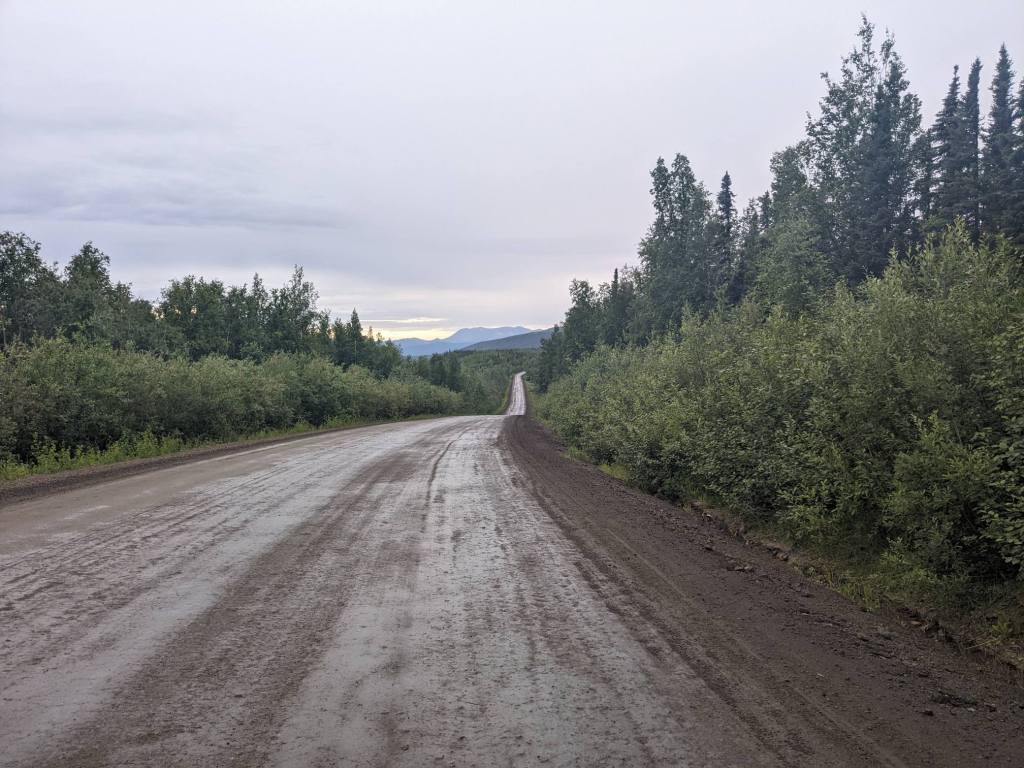
Up and down I went for the next few hours. I collected some more water from a creek, which was an unappetizing brown colour. I planned to ride to the next river in the hopes that it would be nicer. Surprisingly, there was some tarmac for a few kilometres between these rivers.
I reached Hess Creek. The water I got here was pretty much the same colour as before, but there were far more mosquitoes, so all I really got for my trouble was badly bitten. I rode up away from the river and started looking for somewhere to camp.
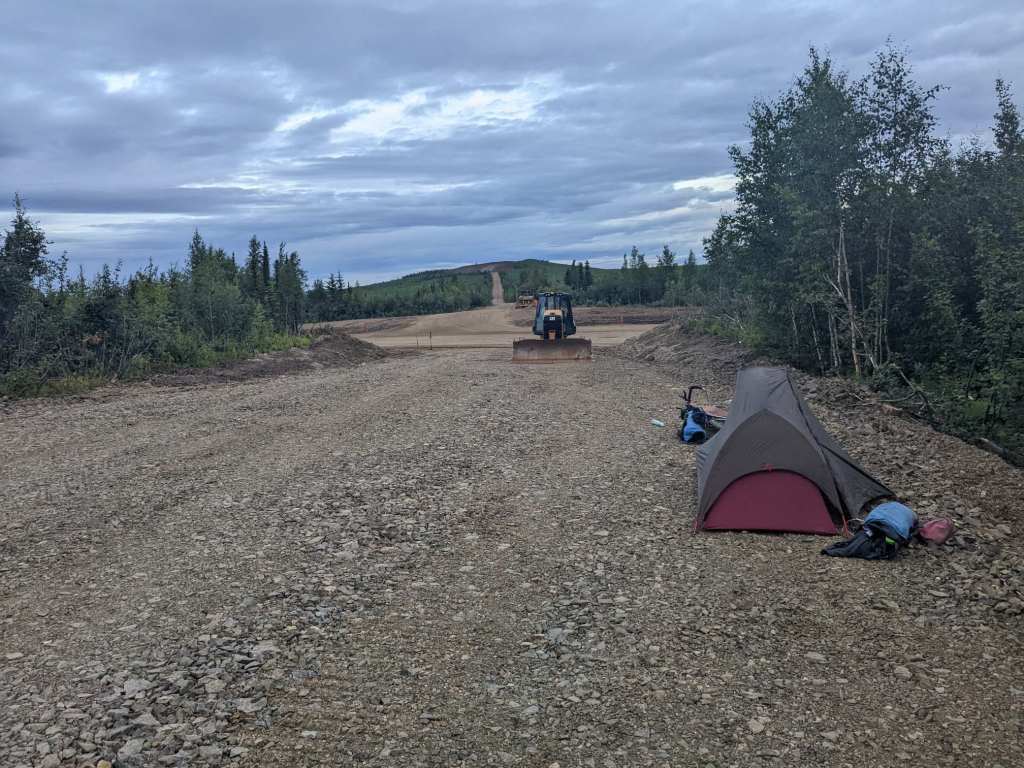
There was a gravel pullout where a grader was parked. I considered stopping there but decided against it, and went to ride off. My rear tyre went flat. I decided I’d stay there after all.
I immediately saw a sharp stone sticking out of the tyre. When I went to patch the tube I discovered I was out of vulcanizing rubber. I had one tube of it left but when I opened it that turned out to be full of air; evidently it had leaked at some point. I put in a spare tube and hoped I wouldn’t have more punctures. I filtered some water then finally went to sleep; it was about 2 AM by this point – and still light!
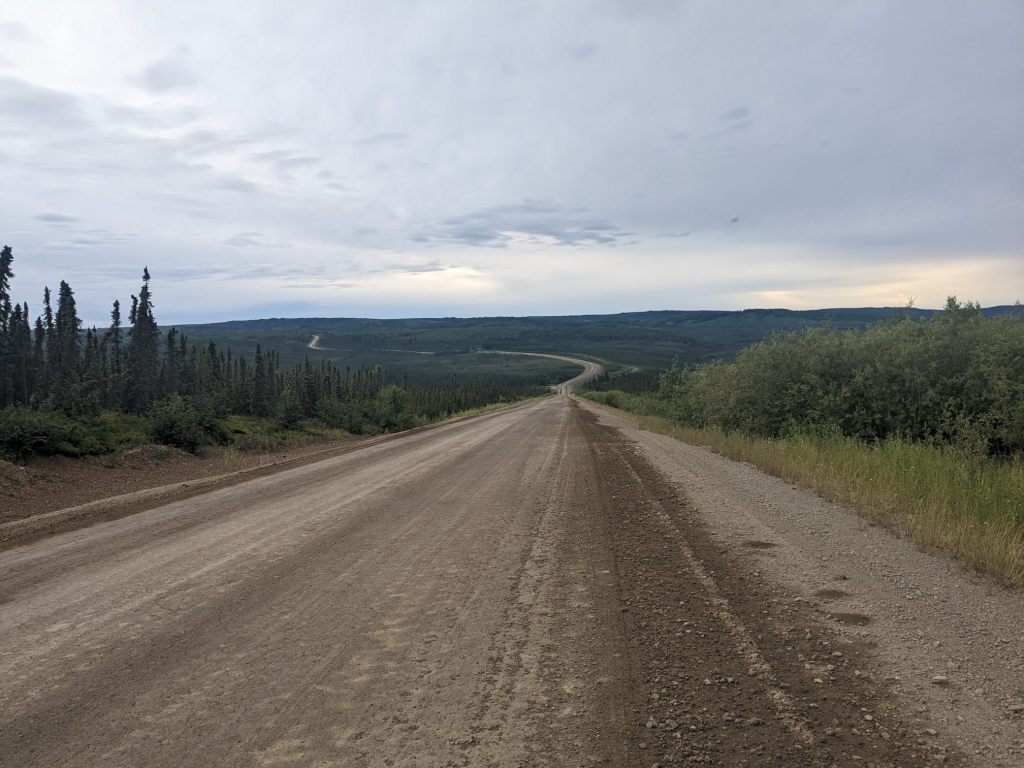
There was a bit of a headwind in the morning, for which I was quite glad – it kept the mosquitoes off. This was a very hilly day and I often had to ride with my head net on as I was surrounded by mosquitoes.
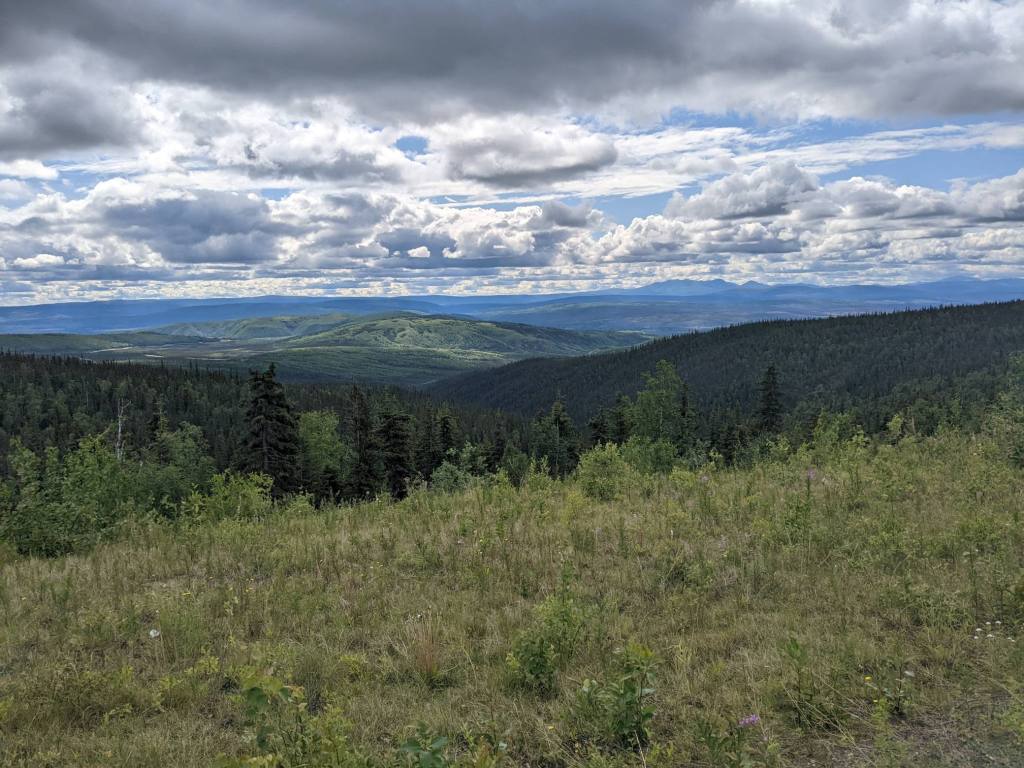
I caught up to a couple of motorcyclists taking a break and they gestured me over to share some beef jerky and chat. I continued on, riding – to my surprise – on tarmac, which lasted some 20km. Afew hours into the day, descended down toward the Yukon river.
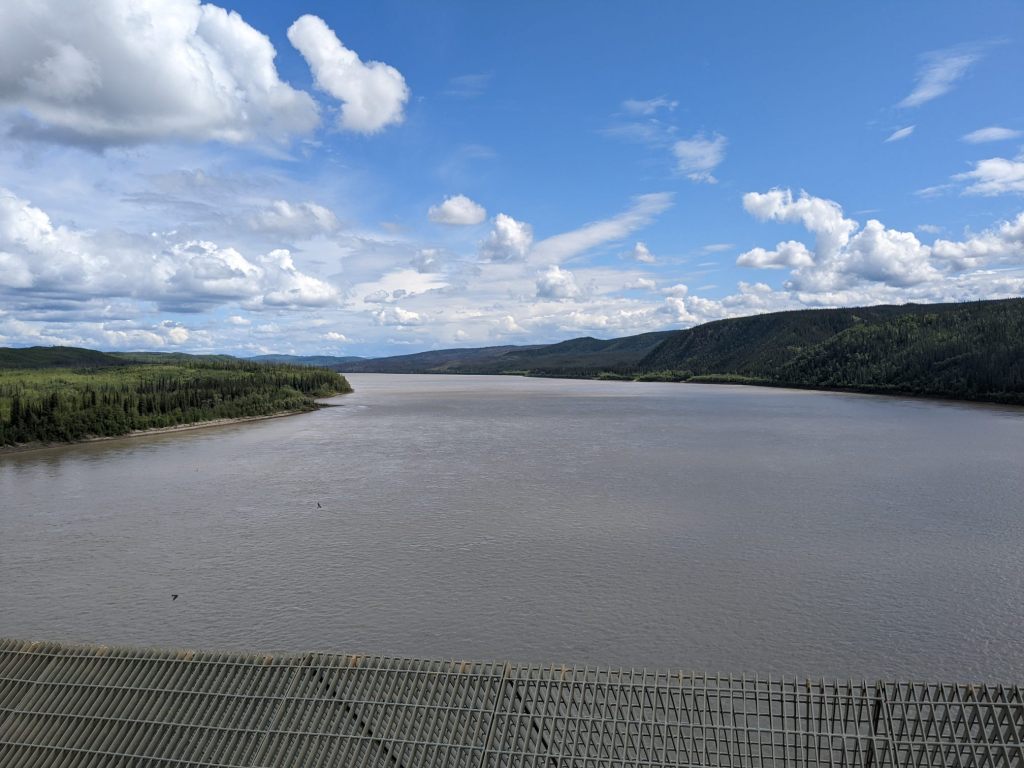
There was a gas station at the far side of the river where I stopped to fill up on water. The motorcyclists were there as well and they kindly gave me some patch cement – for which I was very grateful, as I was uncomfortable knowing all I had was one good spare tube remaining.
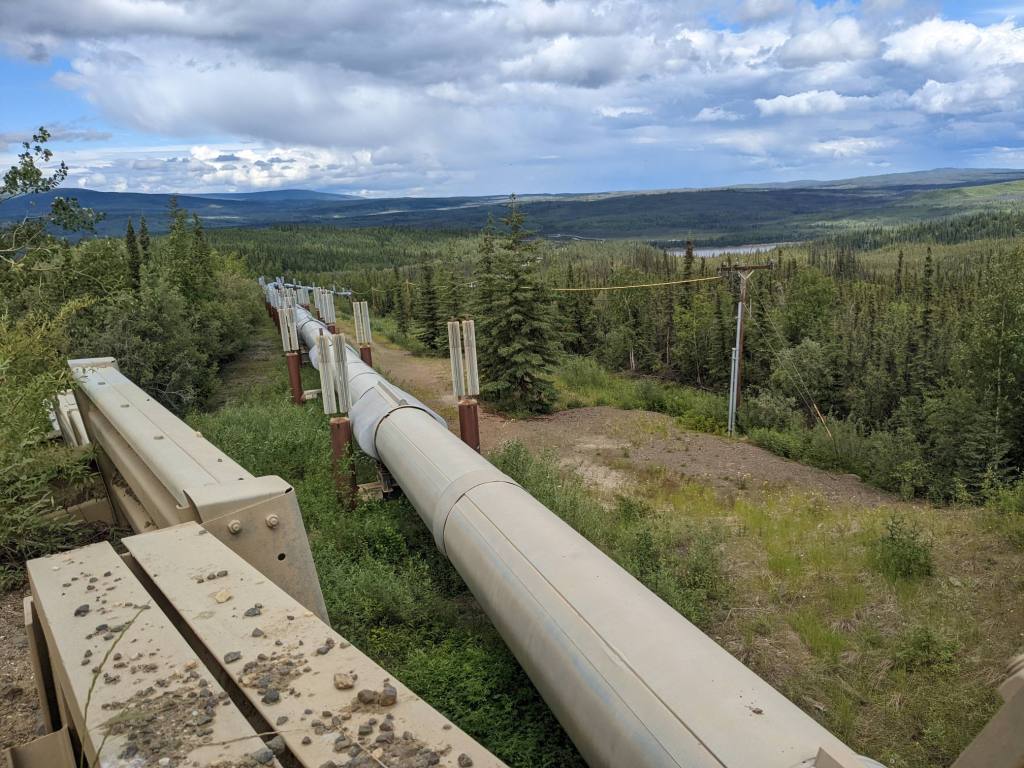
Up and down I went, and up, and down. The entire way along the Dalton Highway a pipeline ran parallel. This was the Trans-Alaska Pipeline.
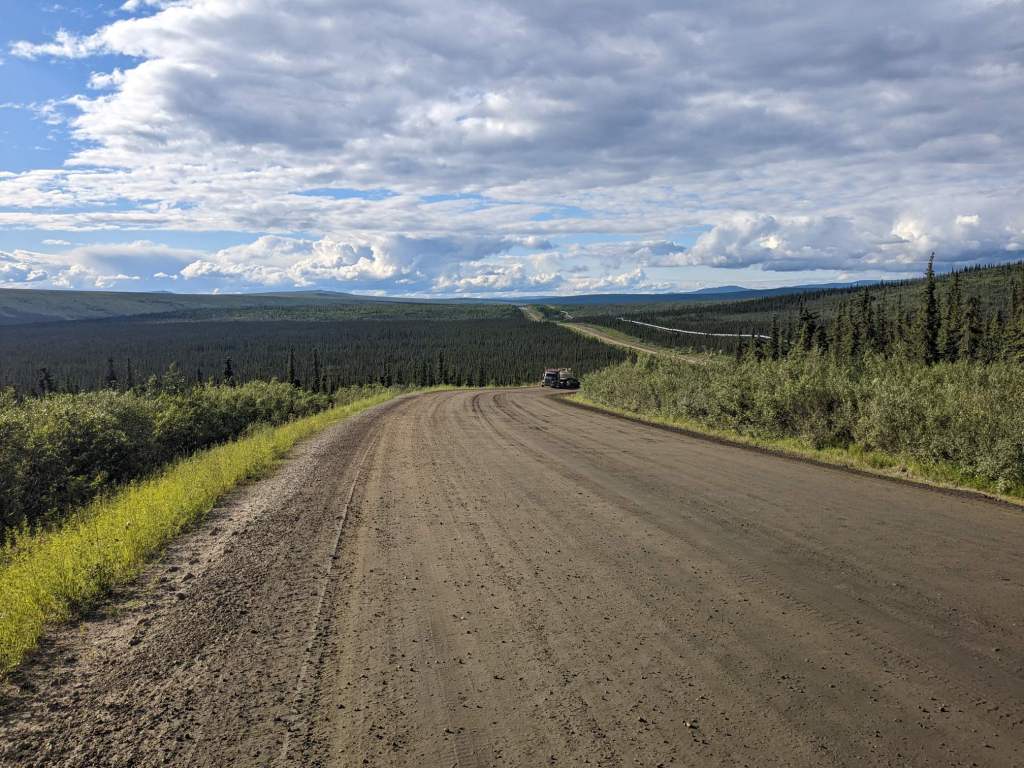
The road began to get more gravelly, which led to a stinging hail of rocks flying my way when trucks passed. Some slowed down a lot which I greatly appreciated. There was one particular climb where the surface was very muddy which slowed me down a lot. I was glad it didn’t last beyond the summit.
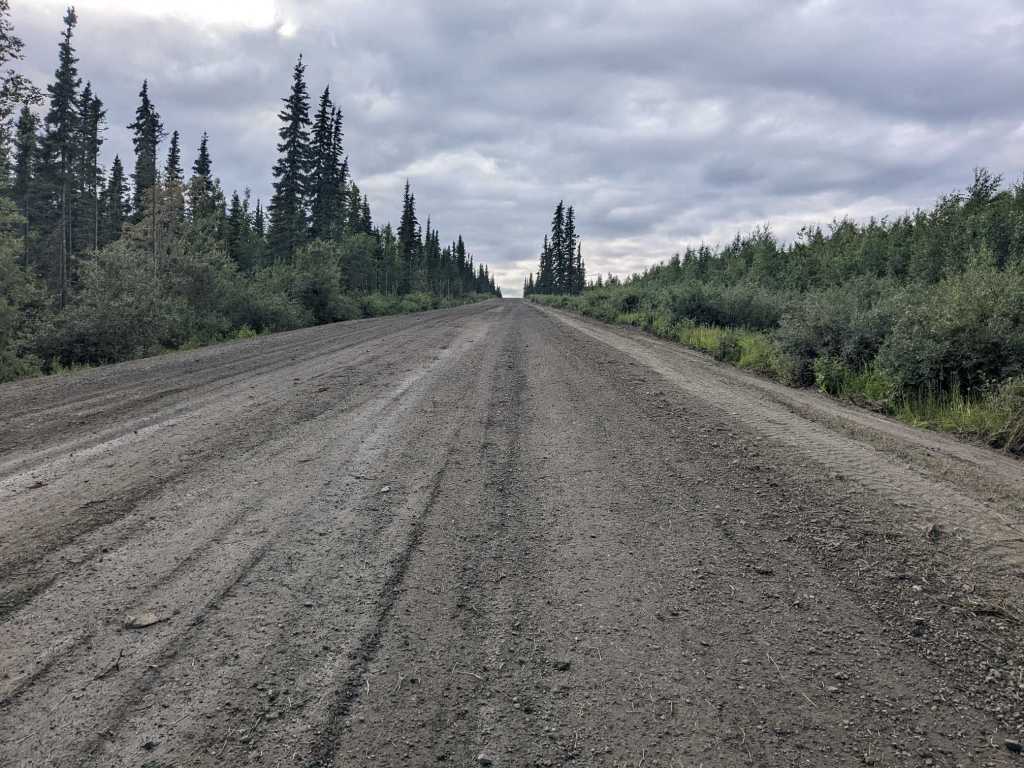
A longer sustained climb in the evening led me up Finger Mountain, atop which was a wide and empty rest area devoid of mosquitoes.
The scenery changed markedly around Finger Mountain. There were far fewer trees and much more low brush as the gradual transition to tundra began.
At the river after Finger Mountain I stopped to collect water and chatted to Adam, a southbound cyclist who was setting up camp there. He’d started a couple days ago and was heading home to Fairbanks.
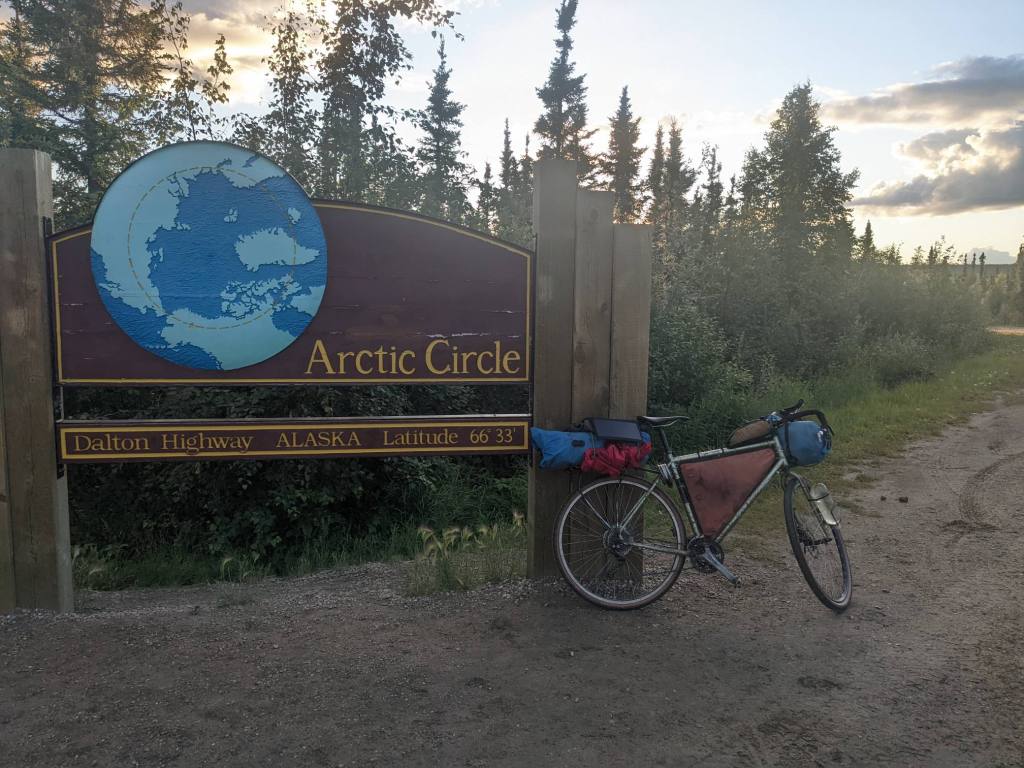
Another hour or so later I reached the Arctic circle. I stopped and took a very quick photo before moving swiftly on to get away from the mosquitoes. They really are unpleasant!
Up again and down again, and then I looked for somewhere to camp. There was a large gravel area by an access track to the pipeline, and I set up my tent there.
The next morning I began the last climb of this first, hilly section of the Dalton Highway. Known (for some reason) as Guzzzler’s Knob, the road here was paved, and would remain so for most of the rest of the day.
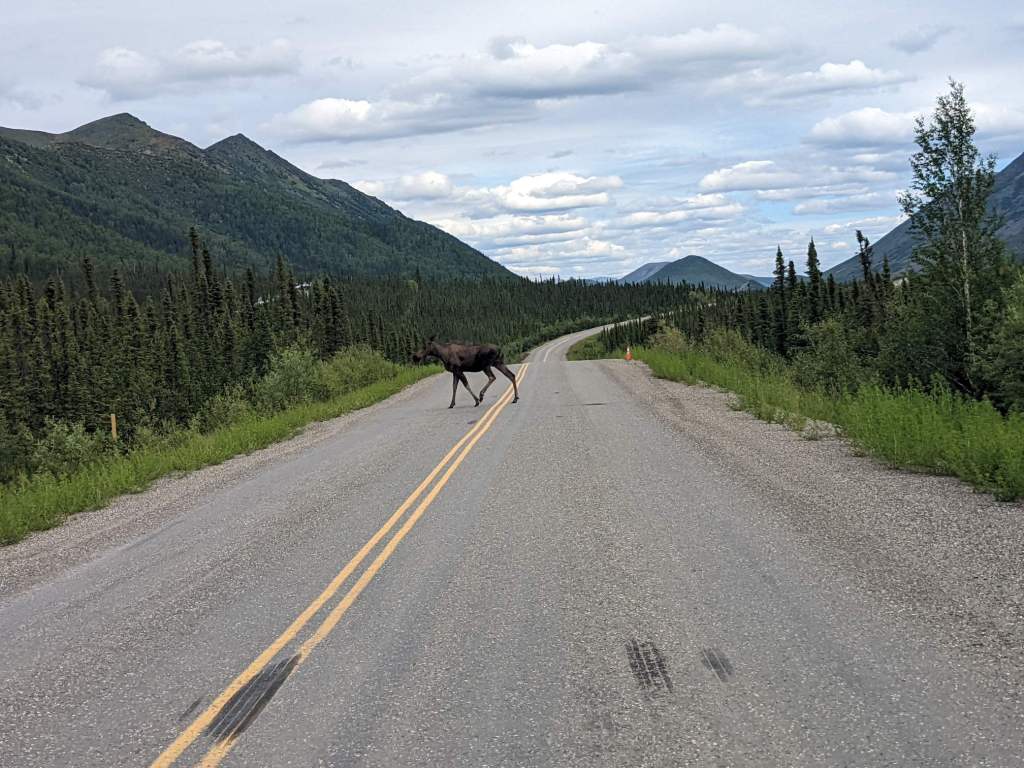
Past the summit the riding was notably easier, with much less climbing for the next few hours. Instead of hills, then, I had a flat tyre. I was relieved to find that it was an old patch peeling – I would not have been impressed for my new tyres to be getting a second puncture so soon. Surrounded by mosquitoes, I fixed it quickly. While doing so I realized one of my spokes had snapped.
I reached Coldfoot, a truck stop. I was very much overdue a shower so I paid the $14 asked. The two motorcyclists from the day before were also at the hotel. Mike and Mike, as I learned they were called, had discovered this morning that one of their batteries was dead. Remarkably, they’d already had a replacement flown in from Fairbanks and planned to resume riding tomorrow.
There weren’t any mosquitoes around so I decided this would be a good spot to repack my bags now that I’d made a dent in the food supplies. Once I’d unpacked, the mosquitoes arrived and I received many bites as I packed back up.
Past Coldfoot the road grew easier again, pretty much flat for several hours along a valley, with a gentle tailwind to assist.
I saw a cyclist stopped at the side of the road and stopped to talk to Michelle, who was waiting for her friend Katie. She had even less on her bike than me! It turned out they had hitch hiked from Coldfoot earlier that day, leaving their gear there, and were riding back. They’d had several problems since starting from Prudhoe Bay – they’d started riding, broken down, hitched to Fairbanks, then back, started riding again, hitched to Coldfoot, then back, and were now riding again!
A little while later the road turned to dirt as I followed the river along this valley. After a couple more hours it was midnight which had begun my habitual time to stop for the day. There was an unused track running parallel to the road, where I set up camp.
The gentle gradient lasted only a short while longer the next morning, before a steep section of 2 kilometers at a 10% gradient led me up to the Chandalar Shelf. I rode alongside a river here, with a few patches of snow nearby.
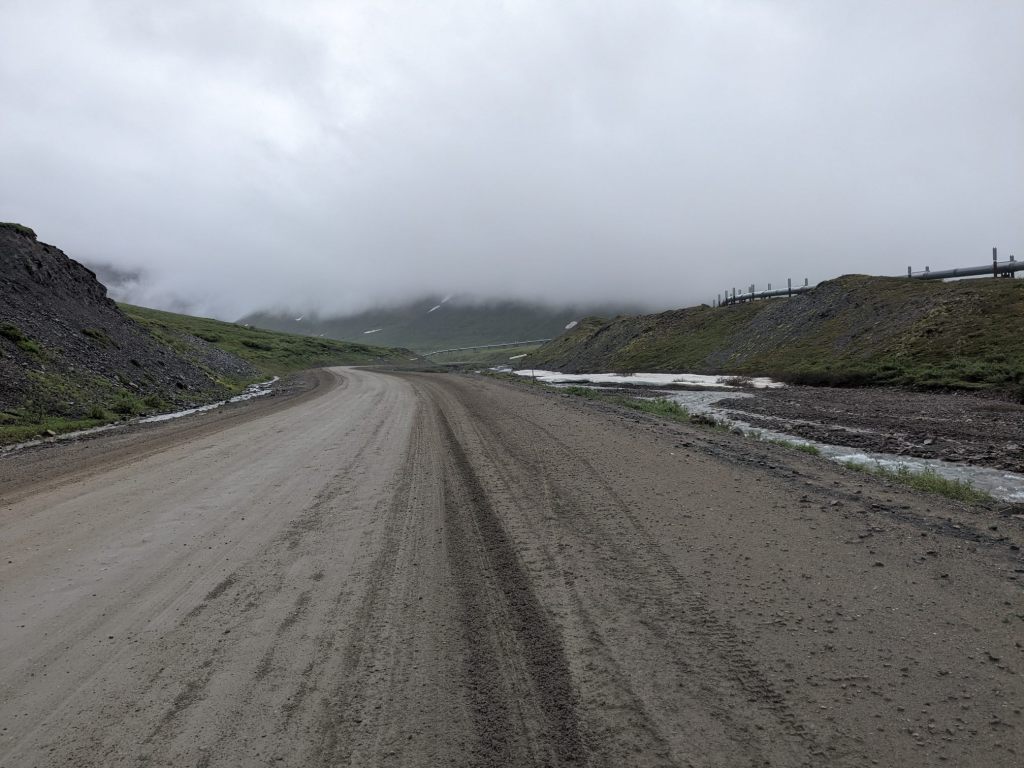
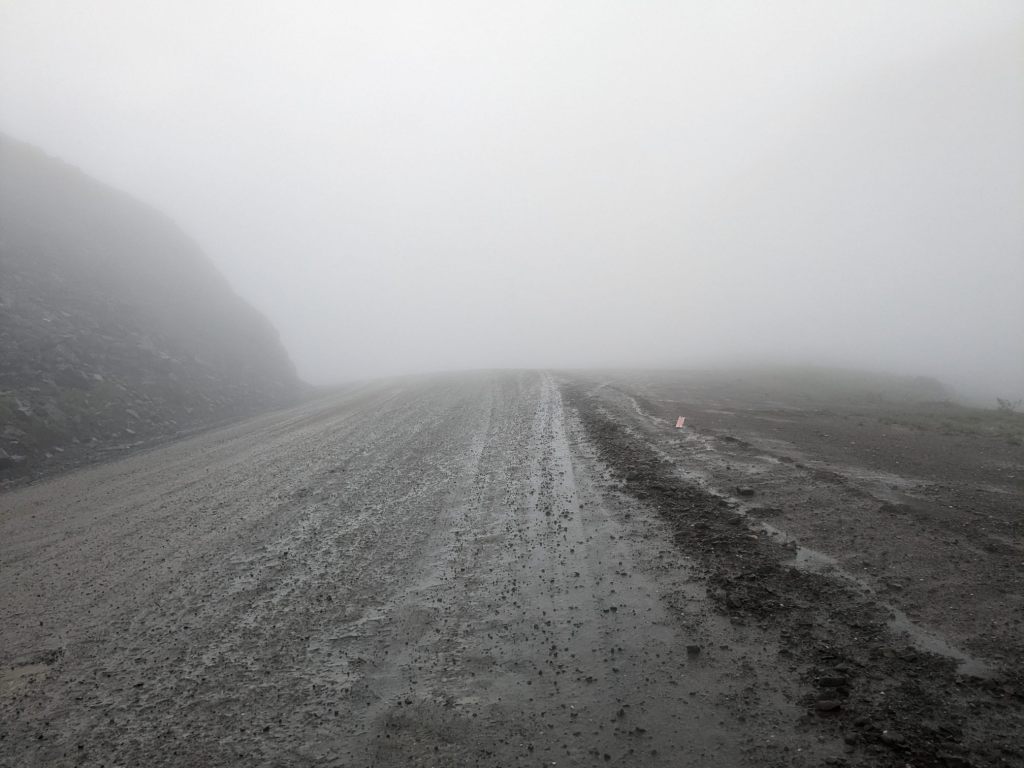
At the end of the shelf was the climb to Atigun Pass. Another 10% gradient brought me up to around 1450m, the highest point of the Dalton Highway. I could see little during the climb as I passed through the clouds.
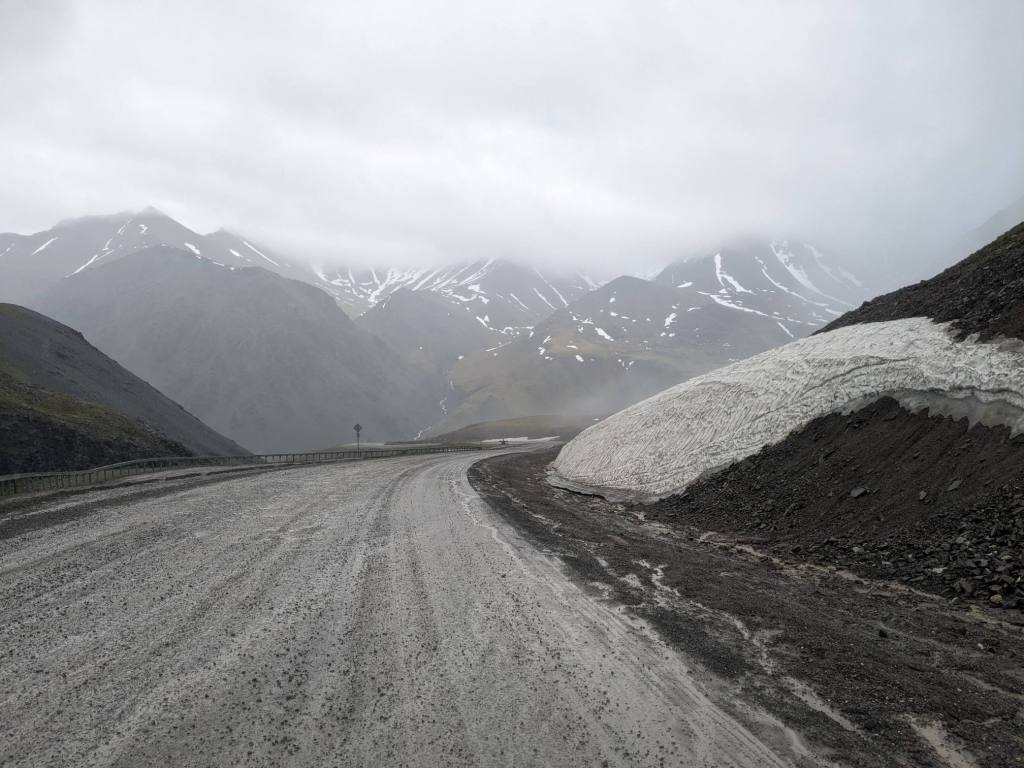
The sky was much clearer on the other side as I descended out of the mountains. Once the road levelled out a strong tailwind pushed me along and I covered distance quickly.
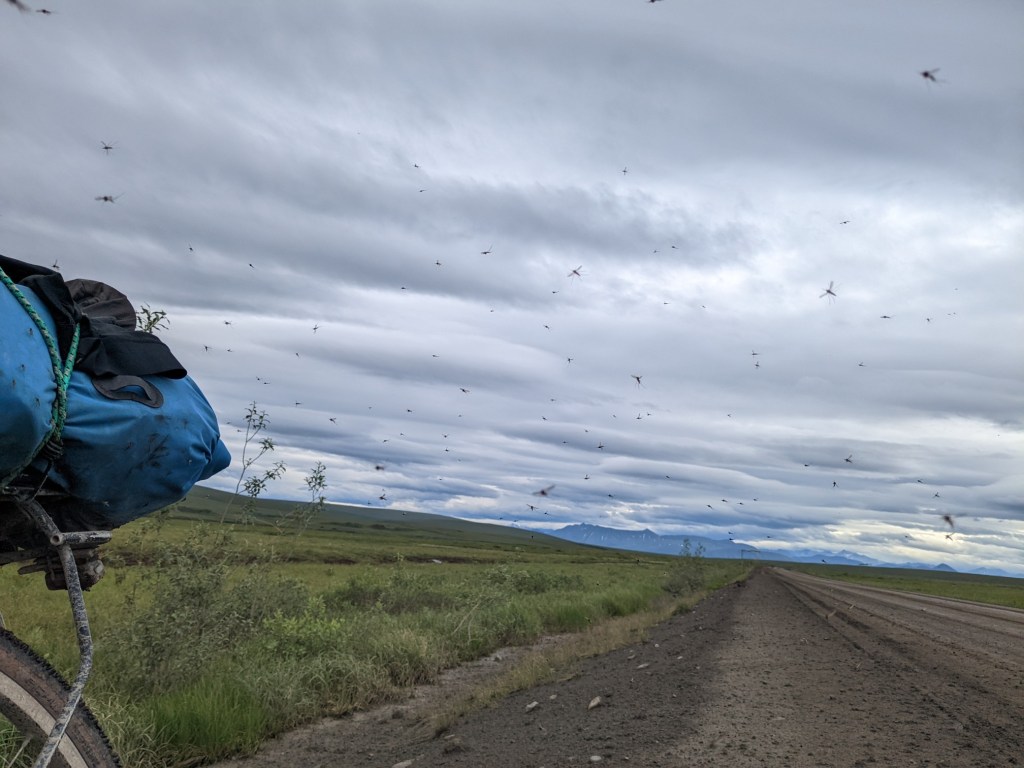
After a time the easy descent turned into a few hills, forcing me to slow down enough for the mosquitoes to catch back up with me. There were even more of them here.
I reached a section of road work. The crew said I could not cycle through – even vehicles were being slowly escorted through by a pilot vehicle. They said I could wait two hours for them to finish for the day, or take a ride for 15km. I decided to take a lift in the pilot vehicle, but would make sure to ride it on the way back.
It was quite interesting chatting with the driver. He was up here working for 5 months, during which time he lives with about a hundred other workers in accommodation built out of shipping containers. He makes enough in that time that he doesn’t need to work the rest of the year.
I resumed riding, continuing to trend downhill. There was a small section of particularly unpleasant mud, thick enough to be flung around by my wheels and make a mess of my drivetrain.
After this muddy section the road climbed up slightly and followed a series of rolling hills. At the roadside I saw a tent – it was the same model as my tent, in fact, but a larger version. I stopped to talk to the French cyclist inside, but moved on quickly due to the mosquitoes.
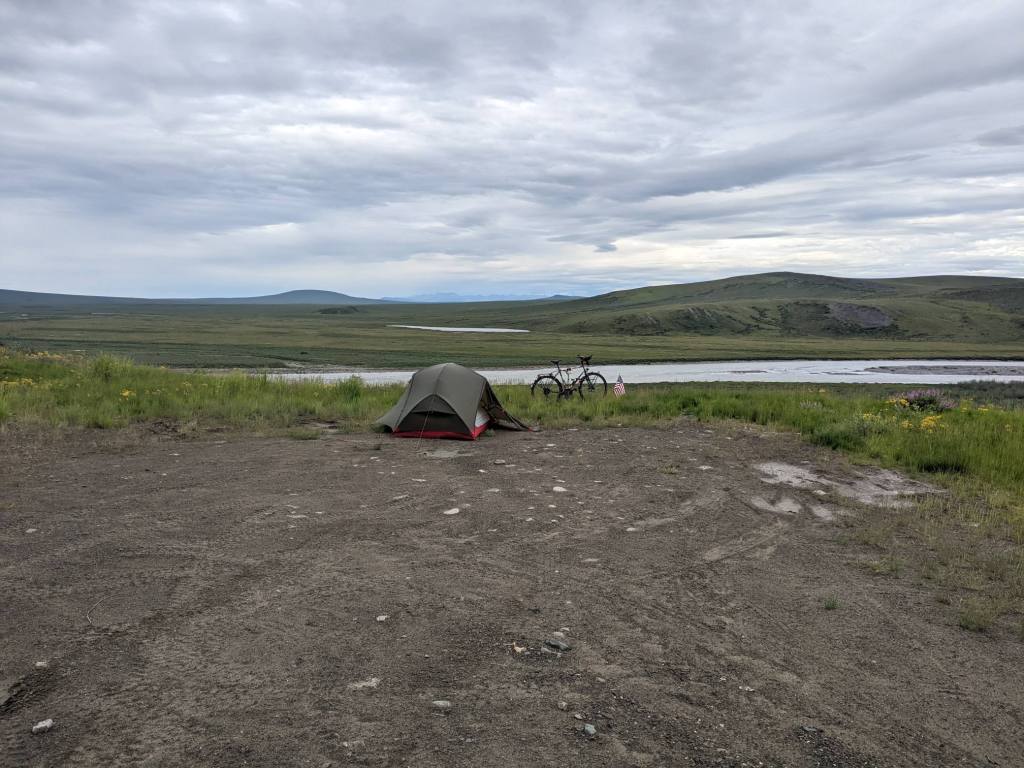
The mosquitoes here were far worse than anything before. After stopping for even a minute the air was thick for them, and riding uphill meant they were able to pursue. I continued along the hills for a little while before pulling over to a gravel area and setting up camp.
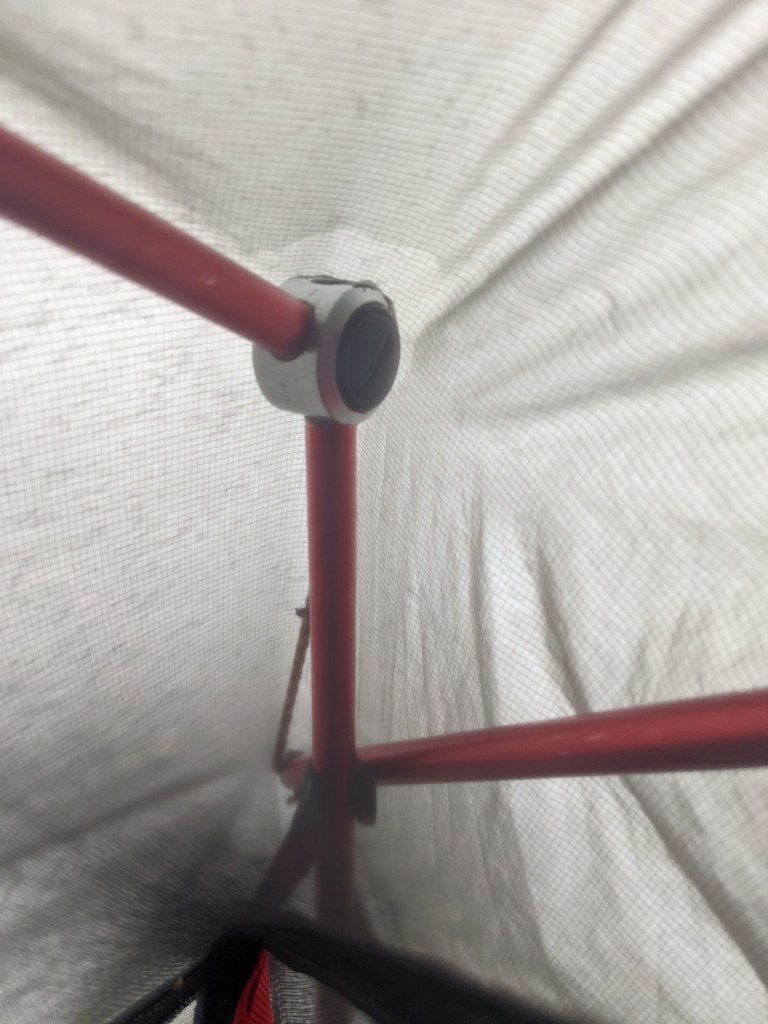
As I got into the tent there was a snapping sound. I thought it was a tent pole but it was in fact slightly worse. There is a central hub piece that the three tent poles all connect to, one of the connections on this has snapped. The tent still mostly held it’s shape but wouldn’t hold up to much of a wind in this state.
In the morning there was just one short climb to go and then I descended down to a tarmac road that would lead me the final 90 km or so to Deadhorse. I met three cycle tourists that morning, but didn’t talk for long due to the ever present mosquitoes. I was running a bit low on water but there were no longer any streams crossing the road, so I walked a few hundred metres over to the larger river.
The final 90km was an imperceptibly gradual descent through featureless terrain, just tundra grassland on either side. A headwind built, minor at first but turning the last hour into a real slog.
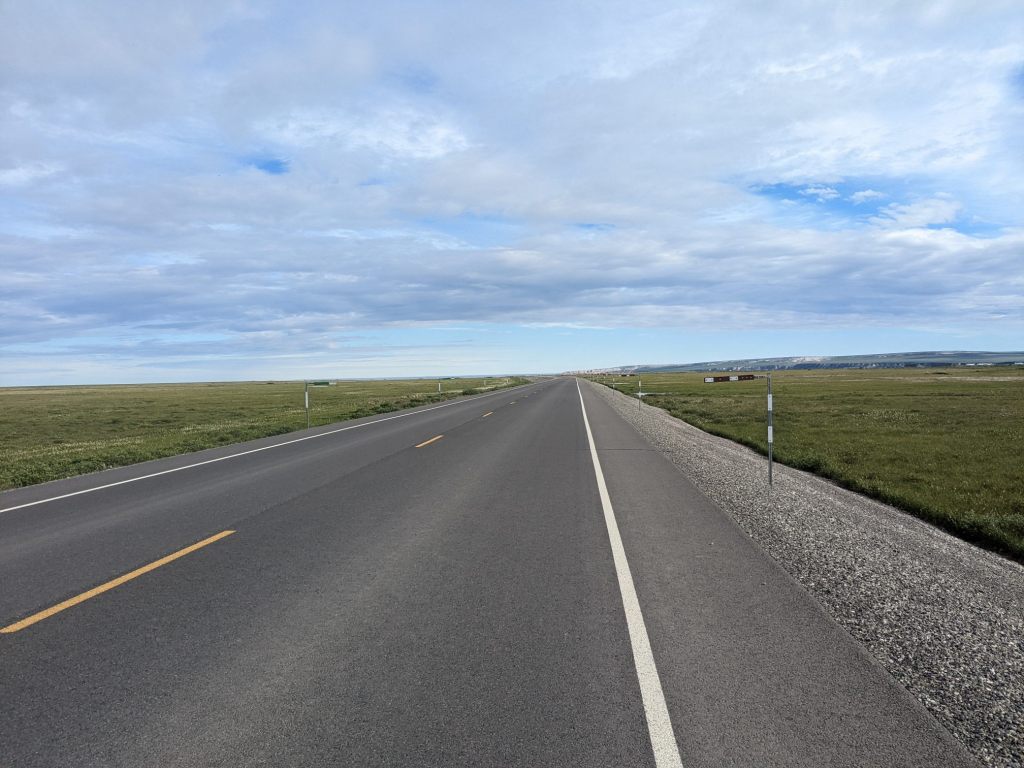
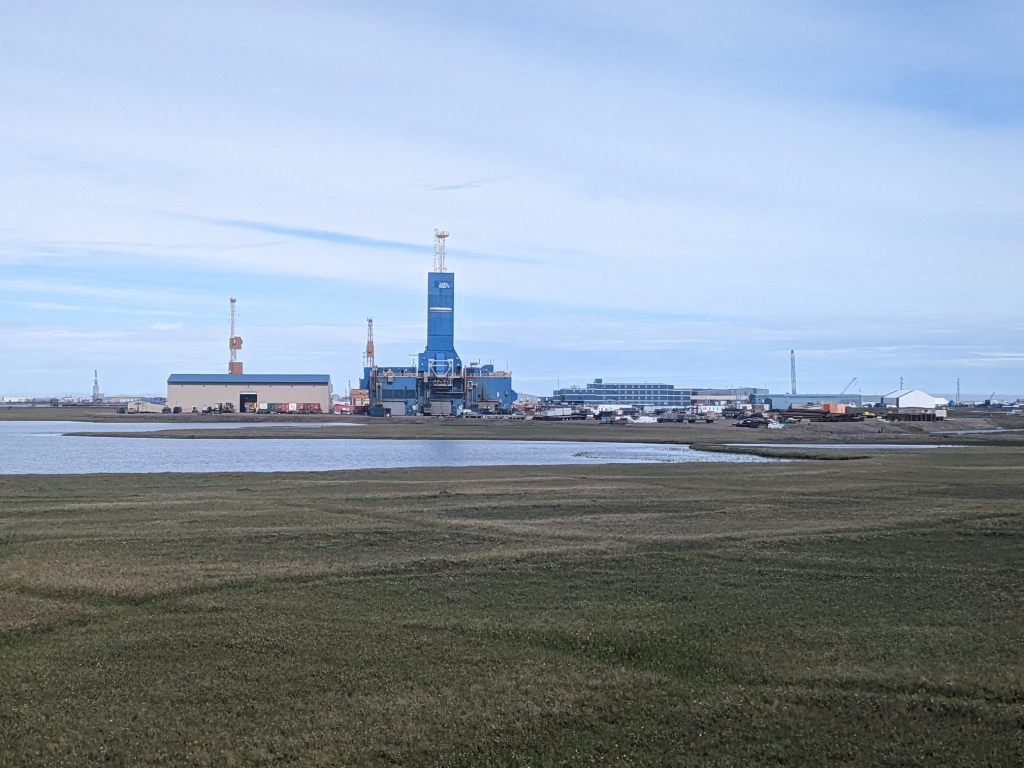
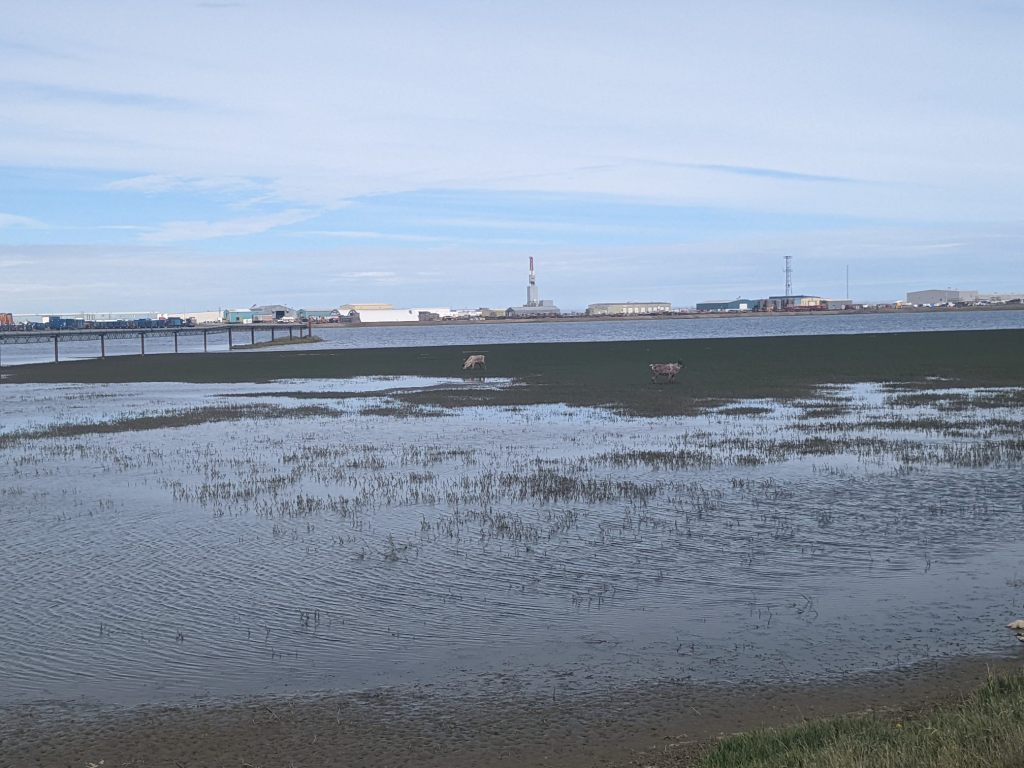
I reached Deadhorse, and made my way around town on a gravel road, passing various equipment storage locations on my way to the general store. The town is mostly a hub for the oil industry so much of the equipment related to that. It was a bit flooded in places and I saw a couple caribou grazing near some water.
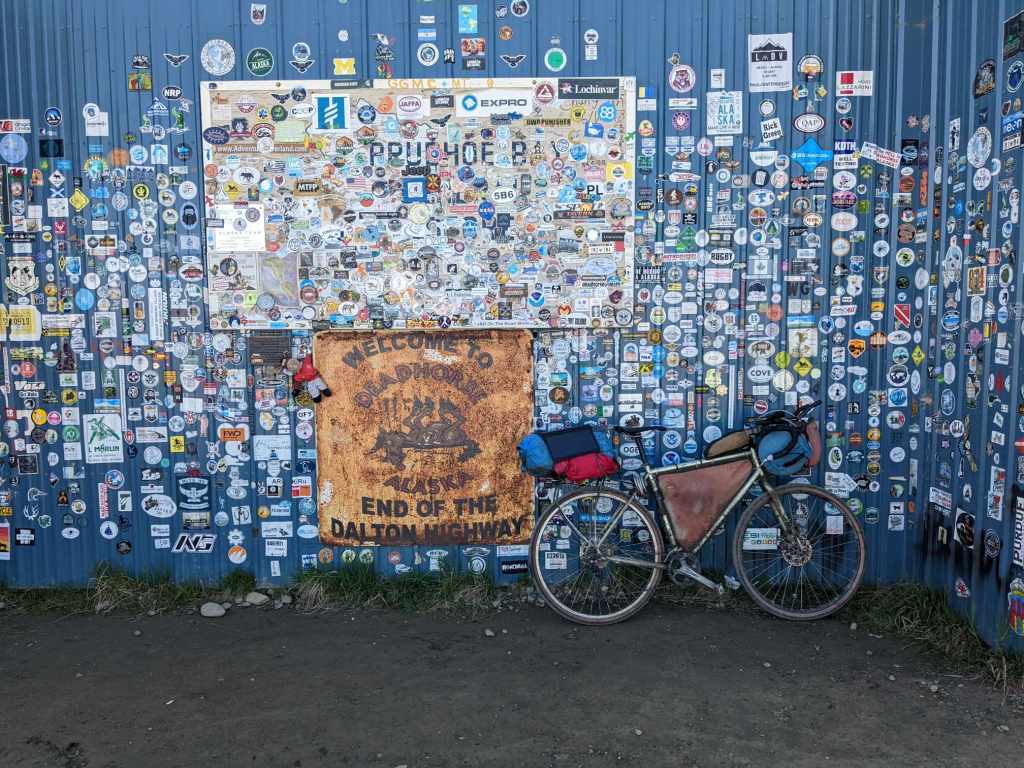
The general store has a sign outside claiming it to be the “official” end of the Dalton Highway. The shop had some not-too-expensive sweets so I bought some to supplement my food for the return journey. There was a hardware store there too where I tried to get my tent poles repaired. There was a “kwik-weld” substance, a kind of superglue for metal. It looked promising but when I went to set up the tent that evening it immediately came off.
After enjoying the relatively mosquito-free environs of Deadhorse there wasn’t much to do but turn around and head back the way I came.
Over the next few days I backtracked along the Dalton Highway. Halfway back I stopped overnight at Coldfoot, and got very good value out of the breakfast buffet at the trucker’s cafe there. There was another cyclist staying there, Lucas, who I’d met on the way north. He’d just started in Prudhoe Bay and his appetite hasn’t yet adjusted to bike touring. He was still eating about 2000 calories a day but that day he’d ridden 170km in mountainous terrain. Unsurprisingly he was exhausted!
I made a late start the next day. On the way south my bike had developed a few problems. The threads securing the bolts of my stem had stripped, so my handlebars could – with a little force – rotate relative to the wheel. The bottom bracket bearings were wearing out and needed replacing. And then, a few hours south of Coldfoot, my freehub failed. Turning the pedals had no effect on the wheel. With some 350km to go I decided to hitch. To be honest, backtracking 800km wasn’t that exciting so I wasn’t too disappointed.
It was about 7PM when my freehub failed and there wasn’t much traffic. In the next hour, only one vehicle went past going in the right direction – a truck, which didn’t stop. There were a few more people going the other way and a couple stopped to check I was okay and to see if I needed anything.
Since it didn’t seem like I’d have much luck hitching, I camped in the woods and tried again the next morning. The first car stopped, but didn’t have space. A couple of pickups went past without stopping. The next driver stopped to make sure I was okay but due to company policy wasn’t allowed to take hitchhikers. As we were talking, one of the pickups that had gone past returned and offered me a lift! It turned out that they’d seen another cyclist some 30km further on and had decided that time to stop, and then figured one of them might as well go back and get me too.
The man driving the pickup was called Golden. He and the other driver had driven up to Deadhorse as escort vehicles to an oversized truck. Apparently the rules vary depending on the length/width of the trucks – above a certain size they have to have plates stating that they’re oversize. A larger size again means they require a pilot vehicle. Yet larger, and they need a vehicle both ahead and behind. The truck they escorted was packed at 2 feet over this threshold so Golden had been called in to act as escort at the last moment. He makes the trip two to three times a week, both as a truck driver and pilot driver. Interestingly, the pilot drivers are paid much better, as they provide their own vehicles. He earned about $1800 for the two day journey.
Golden dropped me and the other cyclist off at REI in Fairbanks. They replaced the freehub. While the guy was replacing it, he saw some threaded part of the hub was stripped. He said it was probably already like that but there was a chance he did it, so he gave me a free wheel. The folks there were friendly and the price came out to a lot less than it should have.
They didn’t have the bottom bracket or stem that I needed but contacted another bike shop to confirm they did. I rode over there next and had those replaced.
I stayed at a hostel in Fairbanks and returned to REI the next morning to replace my tent. My old one has enough problems that it just wouldn’t have made sense to pay to fix it. I also got a haircut (not at REI), then went to Walmart to buy enough food to get to Whitehorse, 1000km away.
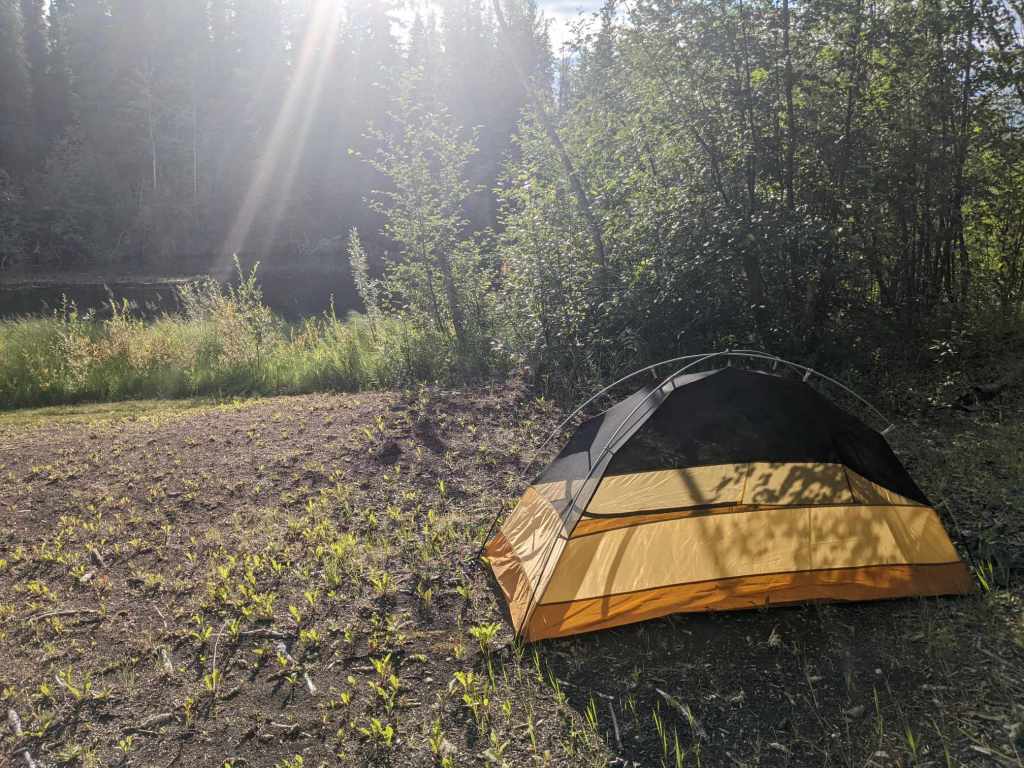
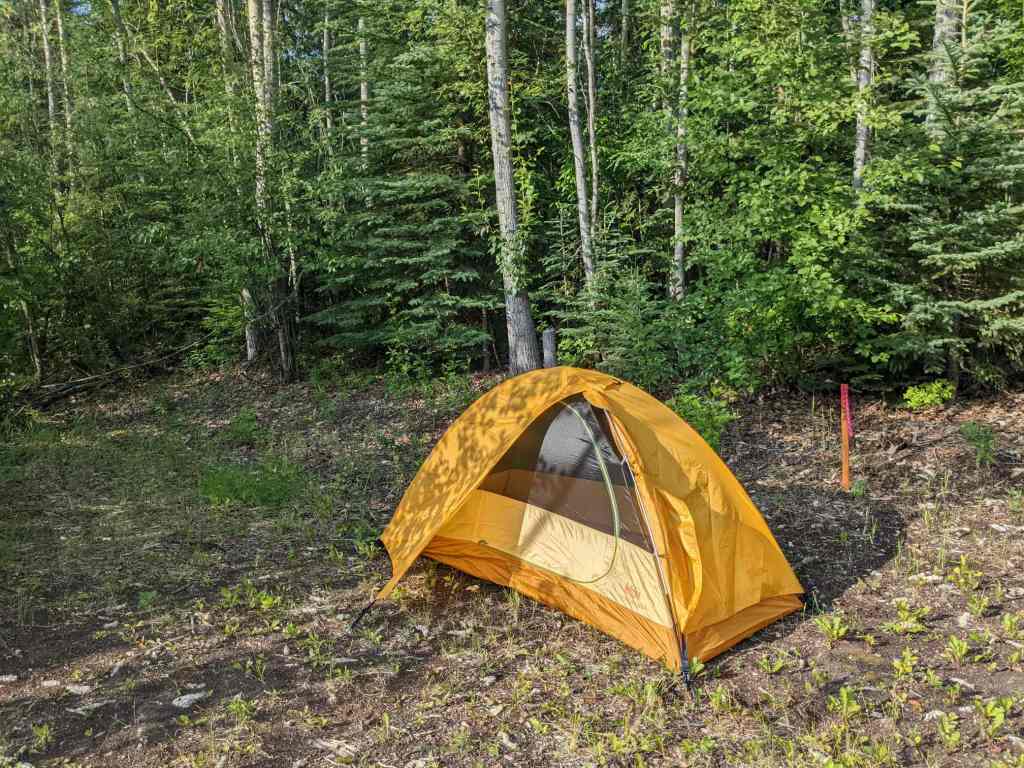
I rode a couple hours out of Fairbanks and stopped early, because I wanted to make an early start the next day to try and see how far I could cycle in one day. I camped at a free campsite by a river. The tent is a little heavier than my old one but seems sturdier, and is completely freestanding. The main drawback is the colour which isn’t as well disguised.
July 3: 198 km
July 4: 151 km
July 5: 175 km
July 6: 184 km
July 7: 202 km
July 8: 146 km
July 9: 144 km
July 10: 76 km
July 12: 42 km
 Cycle Touring Sam
Mossie hell Sam. Not your fav leg so far .. but you remain undefeated!
Lynda
LikeLike
Eeks! I wonder if it was all that mud that somehow penetrated your freehub and jammed the pawls closed. Something similar happened to a friend while the two of us were riding in November. He’d made the mistake of washing off his bike; the water got into his free hub and at a certain point the pawls froze closed. He could pedal, but the freehub wouldn’t engage with the wheel. We had to take turns peeing on his free hub in order to thaw out the pawls. That worked for a while but they would eventually freeze shut again. After that, having voided our bladders, we had to resort to throwing his rear wheel into a stream that wasn’t frozen in order to free up the frozen pawls. The mosquitoes sound bad – not that they’re ever good. Best of luck on the trip south.
LikeLike
Well, whatever it takes eh! Yeah, I imagine some mud had got in there. It had done a decent distance since I last replaced the freehub in Malawi so I feel I got pretty good use out of it.
Sam
LikeLike
Hi Sam,
Now I’m famous. I was mentioned 2 times by you 🙂
Lucas from Denmark.
LikeLike